What strumming is
Strumming is sweeping a pick — or the back of your fingernails and the pad of your thumb — across several strings in one motion, so a whole chord sounds as a single rhythmic gesture. It is the technique that turns a handful of chord shapes into an actual song: the fretting hand decides which notes ring, and the strumming hand decides when and how hard they sound. This guide is about that second job — the rhythm.
Almost every accompaniment part you have ever heard — folk, pop, rock, country, reggae, ballads — is built by laying a short, repeating strum pattern over a chord progression. Learn a handful of those patterns and how to keep them in time, and you can back thousands of songs. Best of all, strumming is a beginner technique: the motion is simple, and the real skill is timekeeping, which any player can build with a metronome and a little patience.
Hear it and play along in the trainer
Open the Strumming-Pattern Trainer to hear and see every pattern in this guide: a beat highlight walks across the strokes at any tempo you set, the fastest way to feel a groove in your hands.
How to play it
A good strum is loose, even, and never stops moving. Four habits are the whole foundation:
Hold the pick lightly
Pinch the pick between the pad of your thumb and the side of your index finger, only a small triangle of tip showing. Hold it loosely enough that it flexes as it drags across the strings — a rigid, clenched grip makes the strum stiff, harsh, and tiring.
Move from the wrist
The strum is a relaxed rotation of the wrist and forearm — like turning a doorknob or shaking water off your fingertips — not a swing of the whole arm at the elbow. Keep the motion small; the wrist is where evenness and control live.
Keep the hand moving
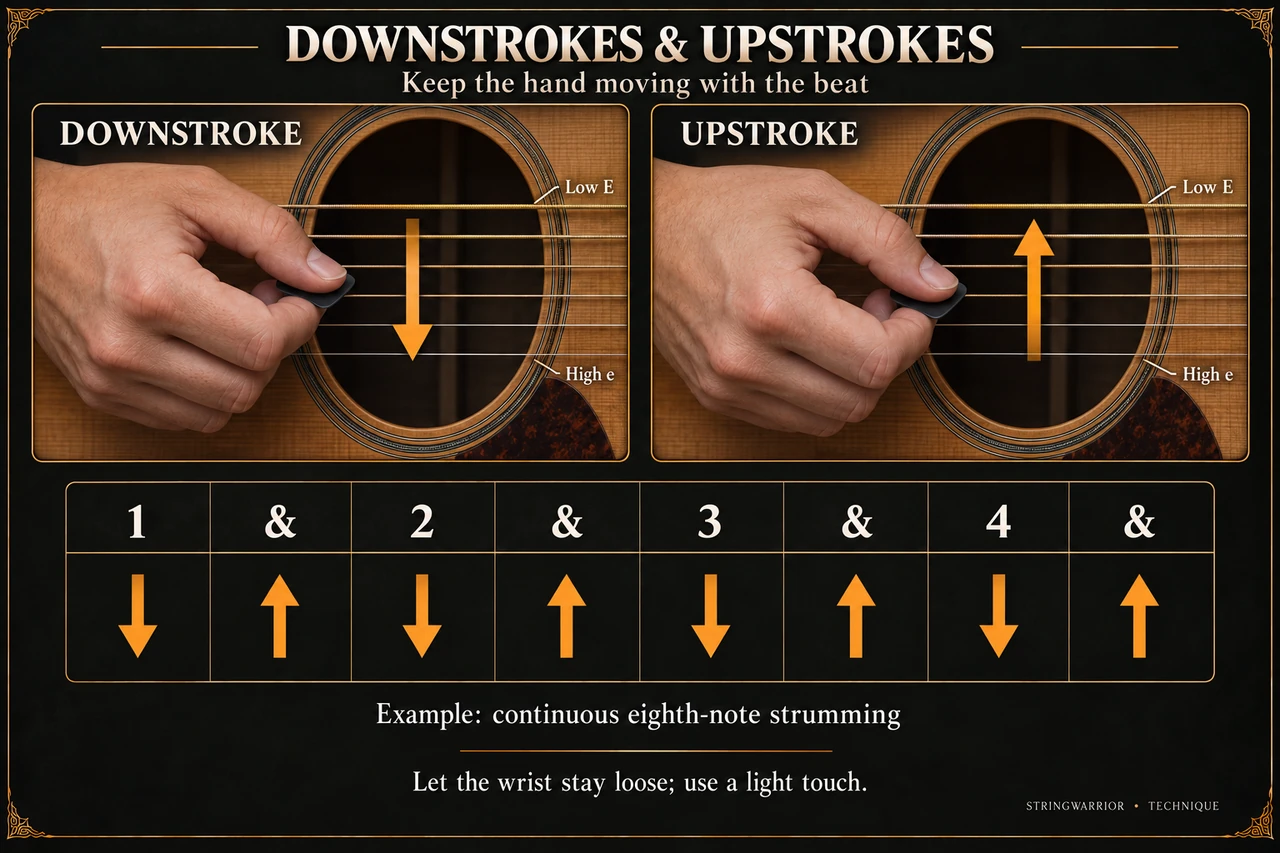
The most important habit in strumming: the hand keeps swinging down and up in a steady pendulum the entire time, even on beats where you do not touch the strings. Those silent "ghost" strokes hold your timing together — never stop the hand.
Mind the down and up
Downstrokes land on the main beats and hit harder; upstrokes are lighter and usually catch only the top three or four strings, which is fine. You do not need all six every time — aim each downstroke at the chord's lowest fretted string.
To put it together, count the rhythm out loud — "one and two and three and four and" — and match your hand to it: down on the numbers, up on the "and" counts. A basic all-eighth-note strum, with the hand contacting the strings on every swing, looks like this:
Count:  1   &   2   &   3   &   4   &
Strum:  ↓   ↑   ↓   ↑   ↓   ↑   ↓   ↑
Once that is smooth and even, you make different patterns simply by leaving some strokes out — while the hand keeps swinging through the gaps. The pattern library below is a set of those.
Tip: Practise with a steady pulse from the very start. Strumming is timekeeping first and chords second, so put on the metronome or a drum groove and stay glued to it.
Common mistakes
Stopping the hand
The biggest one. Freezing your strumming hand to find the next stroke wrecks your timing. Keep the pendulum swinging through every rest and just miss the strings.
Gripping the pick too tight
A clenched pick snags the strings, sounds harsh, and builds tension. Loosen your hold until the pick bends slightly as it passes across the strings.
Always hitting all six strings
Many chords — D, C, A shapes — should start on the D or A string, not the low E. Sweeping all six makes them muddy. Aim each downstroke at the chord's lowest fretted string.
Rushing and dragging
Players speed up through busy strums and slow down through sparse ones. A metronome — and recording yourself back — exposes it quickly and trains it out.
Digging in for volume
Hitting harder is not the same as grooving. Let dynamics come from accents and lighter in-between strokes, not from brute force on every strum.
Buzzy chords under the strum
If a chord only sounds bad when you strum it, the shape is not fully fretted. Check that every note rings cleanly one string at a time in the chord library first.
A reference library of strumming patterns
Below are common strumming patterns written as arrow charts. Read each one left to right in time with the count underneath your breath. These rhythms are generic, uncopyrightable feels — the building blocks under countless songs, not any one recording.
How to read the charts:
- ↓ — downstroke ↑ — upstroke
- ⇓ / ⇑ — an accented (louder) down- or up-stroke: the pulse of the pattern
- · — a rest: keep the hand swinging in time but miss the strings (a ghost stroke)
All Downstrokes — 4/4, beginner
Count:  1   &   2   &   3   &   4   &
Strum:  ⇓   ·   ↓   ·   ⇓   ·   ↓   ·
The foundation strum: one firm downstroke on every beat. Steady, even, and the first pattern every beginner should own before adding upstrokes.
Eighth-Note Down-Up — 4/4, beginner
Count:  1   &   2   &   3   &   4   &
Strum:  ⇓   ↑   ↓   ↑   ⇓   ↑   ↓   ↑
Continuous down-up eighths that keep the hand in constant pendulum motion — the groove machine behind fast folk and pop rhythm playing.
The Most Common Strum, "D-DU-UDU" — 4/4, beginner
Count:  1   &   2   &   3   &   4   &
Strum:  ⇓   ·   ↓   ↑   ·   ↑   ↓   ↑
The ubiquitous down, down-up, up-down-up pattern behind countless campfire and pop songs. Miss the strings on the two rests while your arm keeps swinging — that is the whole trick.
Backbeat Eighths — 4/4, intermediate
Count:  1   &   2   &   3   &   4   &
Strum:  ↓   ↑   ⇓   ↑   ↓   ↑   ⇓   ↑
Down-up eighths with the accent shifted onto beats 2 and 4 — the backbeat feel that makes a rhythm part sit in the pocket with the snare drum.
Reggae Skank — 4/4, intermediate
Count:  1   &   2   &   3   &   4   &
Strum:  ·   ⇑   ·   ⇑   ·   ⇑   ·   ⇑
The off-beat "bang": short, accented upstroke chops on the "and" counts, with silence on the beats themselves. Keep every stroke crisp and clipped.
Waltz — 3/4, beginner
Count:  1   &   2   &   3   &
Strum:  ⇓   ·   ↓   ↑   ↓   ↑
A three-beat sway: a strong downstroke on beat 1, then down-up strums on beats 2 and 3 for the lilting one-two-three of a waltz.
6/8 Ballad — 6/8, intermediate
Count:  1   2   3   4   5   6
Strum:  ⇓   ·   ↓   ⇓   ·   ↑
The slow compound lilt of 6/8: two dotted pulses per bar with an up-strum lead-in on the last eighth — the rocking feel of many slow blues-ballads.
16th-Note Funk — 4/4 in sixteenths, advanced
Count:  1   e   &   a   2   e   &   a   3   e   &   a   4   e   &   a
Strum:  ⇓   ↑   ↓   ↑   ⇓   ↑   ↓   ↑   ⇓   ↑   ↓   ↑   ⇓   ↑   ↓   ↑
Constant sixteenth-note down-up motion with accented open hits on the beats and lighter strokes between — mute most of the in-between strokes with your fretting hand for the percussive "wacka" scratch at the heart of funk.
Every pattern here — plus eight more across country, ska, funk, and blues — is playable in the Strumming-Pattern Trainer, where a moving highlight walks the beat at whatever tempo you choose. Start each one slow, get it even, and only then push the speed.
How to build it up
Take the patterns above in order of difficulty. Spend a session or two on each before moving on, and loop every pattern over a slow two-chord change so your strum survives the chord switches:
- All downstrokes on the beat. Get them dead even and every chord ringing clean.
- Straight down-up eighths. Add the upstrokes and settle into the constant pendulum.
- The D-DU-UDU pattern. Your first syncopation — leaving strokes out without ever stopping the hand.
- Shift the accent to beats 2 and 4 for a backbeat feel.
- New meters. Try the 3/4 waltz and the 6/8 lilt so 4/4 is not your only gear.
- Sixteenth-note and muted-scratch funk for tight, percussive rhythm playing.
Then take it to real music. The guided Your First Strum lesson walks you through the basics in order, the Campfire Four routine drills strumming through chord changes, and the Songbook is full of simple, public-domain songs to play your new patterns over.
Related on String Warrior
Take strumming further and connect it to the rest of your playing:
- All guitar techniques
- Strumming-Pattern Trainer
- Fingerpicking — the plucked alternative to strumming
- String & fretting-hand muting — for tight, percussive strums
- Palm muting
- Guitar chord library
- Guitar licks and exercises
- Guided practice routines
- Songbook — including 3/4 tunes like Down in the Valley
- How to read tab
Strumming FAQ
- Is strumming hard to learn?
- It is a beginner-level technique, and the motion itself is simple: down and up across the strings. The hard part is timekeeping. Keep your strumming hand swinging in a steady pendulum, start slowly with a metronome, and it becomes automatic within a few short practice sessions.
- What instruments does strumming apply to?
- Guitar, ukulele, mandolin, and banjo — any chordal string instrument you brush rather than pluck one note at a time. The core down-up motion transfers across all of them, with small adjustments for string spacing and how many strings you sweep.
- Should I strum with a pick or with my fingers?
- Either works. A pick gives a brighter, louder, more even attack and is the usual choice on steel-string guitar; strumming with the back of the fingernails and the pad of the thumb gives a warmer, softer sound common on ukulele and nylon-string guitar. Learn the rhythm first — it is the same in both hands.
- What is the most common strumming pattern?
- The "D-DU-UDU" pattern — down, down-up, up-down-up over one bar of 4/4 — is the single most common strum in folk and pop. The trick is to keep your hand moving through the missed strokes so the timing never wavers.
- How do I keep my strumming hand in time?
- Never stop the hand. Swing it down on the beats and up on the "and" counts continuously, and simply miss the strings on the strokes you do not want to sound. Practising against a metronome or the Strumming-Pattern Trainer locks this "ghost strumming" habit in fast.
- Why do my chords sound bad only when I strum fast?
- Usually the chord is not fully fretted, or you are hitting strings that should stay quiet. Check that every note of the chord rings cleanly one string at a time before you strum it, and aim your downstroke at the chord's lowest fretted string instead of always sweeping all six.