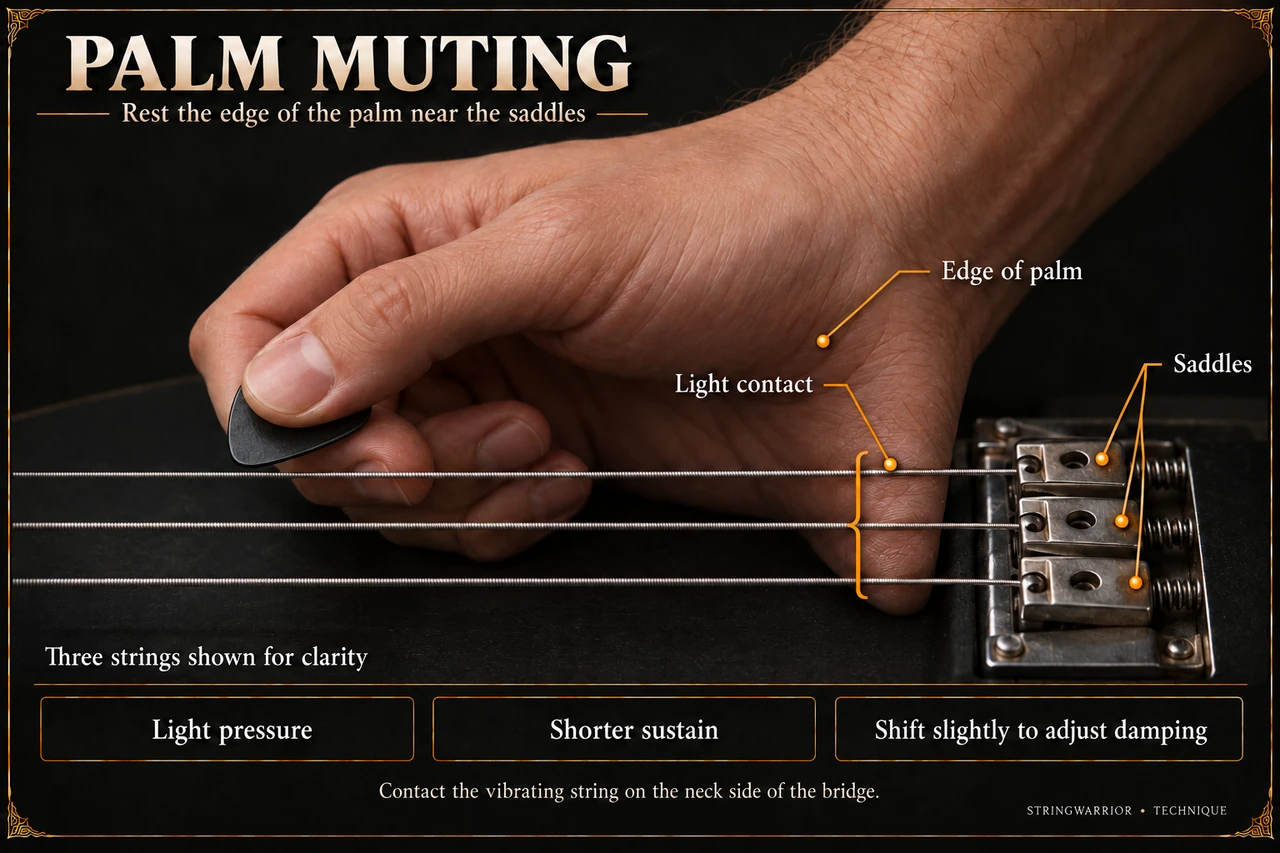
What palm muting is
Palm muting is the engine behind almost every driving rock, metal, punk, and country rhythm part. You rest the fleshy side of your picking hand — the edge below your little finger — lightly on the strings right where they cross the bridge, then pick as normal. The strings still sound their pitch, but the ring is cut short into a tight, thumping "chunk". In tab it is written as P.M. with a dashed line over the muted notes.
The most important thing to understand is that palm muting is a dial, not a switch. Rest gently right at the bridge saddles and you get a fat note with only its tail trimmed. Press a little harder, or slide your hand a few millimetres toward the neck, and the note gets shorter and more percussive. Move too far and it collapses into a dead, pitchless thud. Learning palm muting is really learning to feel that gradient with your hand.
When to use it
Palm muting does two jobs. First, drive and tightness: chugging muted power chords give a riff its punch and let a distorted guitar stay defined instead of smearing into a wall of noise. Second, dynamics and contrast: muting a verse and then lifting your hand to let the chorus ring open is one of the oldest and most effective tricks in songwriting. It also tames boomy low strings on an acoustic and keeps a busy bass line from washing together.
Examples in tab
A note on audio: our engine plays clean plucked notes, so it cannot reproduce palm muting — muting is a physical motion of your picking hand, not a change in pitch. The tab below is a visual reference: read it and hear the chug on your own guitar.
These examples are original and use standard tab. P.M. over a run of notes means keep the palm rested for those notes; where the P.M. line stops, lift the palm and let the string ring.
Example 1 — Steady chug on an open E5. Eight down-picked eighth notes (count "1 & 2 & 3 & 4 &") on a low E5 power chord, palm muted throughout. This is the bread-and-butter driving rhythm.
P.M.------------------------
D|--2--2--2--2--2--2--2--2--
A|--2--2--2--2--2--2--2--2--
E|--0--0--0--0--0--0--0--0--
Example 2 — Mute, then release. Four muted chugs, then let the chord ring open on beat 3. Feel your palm lift off the strings for the ringing note — that lift is the whole technique in a single move.
P.M.------------       let ring
D|--2--2--2--2----2---------
A|--2--2--2--2----2---------
E|--0--0--0--0----0---------
Example 3 — Gallop. The classic down-up-down "gallop": three notes per beat on the muted low E string. Keep it tight and even before you push the tempo.
P.M.-------------------------------
E|--0-0-0---0-0-0---0-0-0---0-0-0--
How to play it
Set your hand up like this and palm muting clicks quickly:
1. Find the spot
Rest the outer edge of your palm — the pad below your pinky — on the strings right where they pass over the bridge. On an electric that is the metal bridge; on an acoustic it is just in front of the round bridge pins.
2. Keep picking normally
Your palm stays put while your thumb and pick keep working. The mute comes from the palm resting, not from how you pick. Use mostly downstrokes for the tightest, most aggressive chug.
3. Dial the pressure
Barely-there contact trims the ring; firmer contact shortens the note further. You want the pitch still audible, just choked — if it becomes a click with no note, you are pressing too hard or sitting too far from the bridge.
4. Move to change the tone
Closer to the bridge means more note and less mute; toward the neck means more mute and less note. Slide your hand a few millimetres to taste — most players park just behind the saddles.
Once the hand position feels natural, the fastest way to build control is short, slow reps against a steady click. Play Example 1 with a metronome at a slow tempo and make every muted eighth note identical in length and volume before you speed up.
Common mistakes to watch for:
- Sitting too far forward. Resting over the pickups instead of at the bridge kills the pitch entirely — slide back toward the bridge until the note returns.
- Pressing too hard. Palm muting is a light rest, not a clamp. Heavy pressure gives a lifeless thud and tires your hand.
- Anchoring so hard you cannot move. Keep the hand mobile so you can lift instantly for open notes and slide to reshape the tone.
- Uneven chugs. If some notes ring longer than others, your palm pressure is drifting; slow down until every hit matches.
Related on String Warrior
Build palm muting into real playing:
- All guitar techniques
- String & fretting-hand muting — the other half of clean, controlled playing
- Alternate picking — the picking-hand mechanics behind fast muted riffs
- Strumming — where mute-and-release dynamics live in rhythm parts
- Guitar exercises and guitar licks to drill it in context
- Guided practice routines and songs to play
- How to read tab, including the P.M. and x symbols
Palm Muting FAQ
- Where exactly do I rest my palm for palm muting?
- Rest the outer edge of your picking-hand palm on the strings right where they cross the bridge saddles. Too far toward the neck and the note dies to a dull thud; too far back and you get almost no muting. Just in front of the saddles is the sweet spot.
- Why does my palm muting sound choked and dead?
- You are almost certainly muting too far forward, toward the pickups, or pressing too hard. Slide your hand back toward the bridge and lighten the pressure until the pitch of the note returns while the ring stays trimmed.
- Is palm muting only for metal and electric guitar?
- No. It runs through rock, punk, pop, and country, and it works on acoustic guitar and bass too. On acoustic it tames boomy low strings; on bass it gives a short, warm, upright-style thump.
- Do I palm mute with a pick or with my fingers?
- Most players palm mute with a pick using downstrokes, because that gives the tightest, most percussive chug. You can still mute while fingerpicking or using your thumb, since the palm does the muting either way.