What alternate picking is
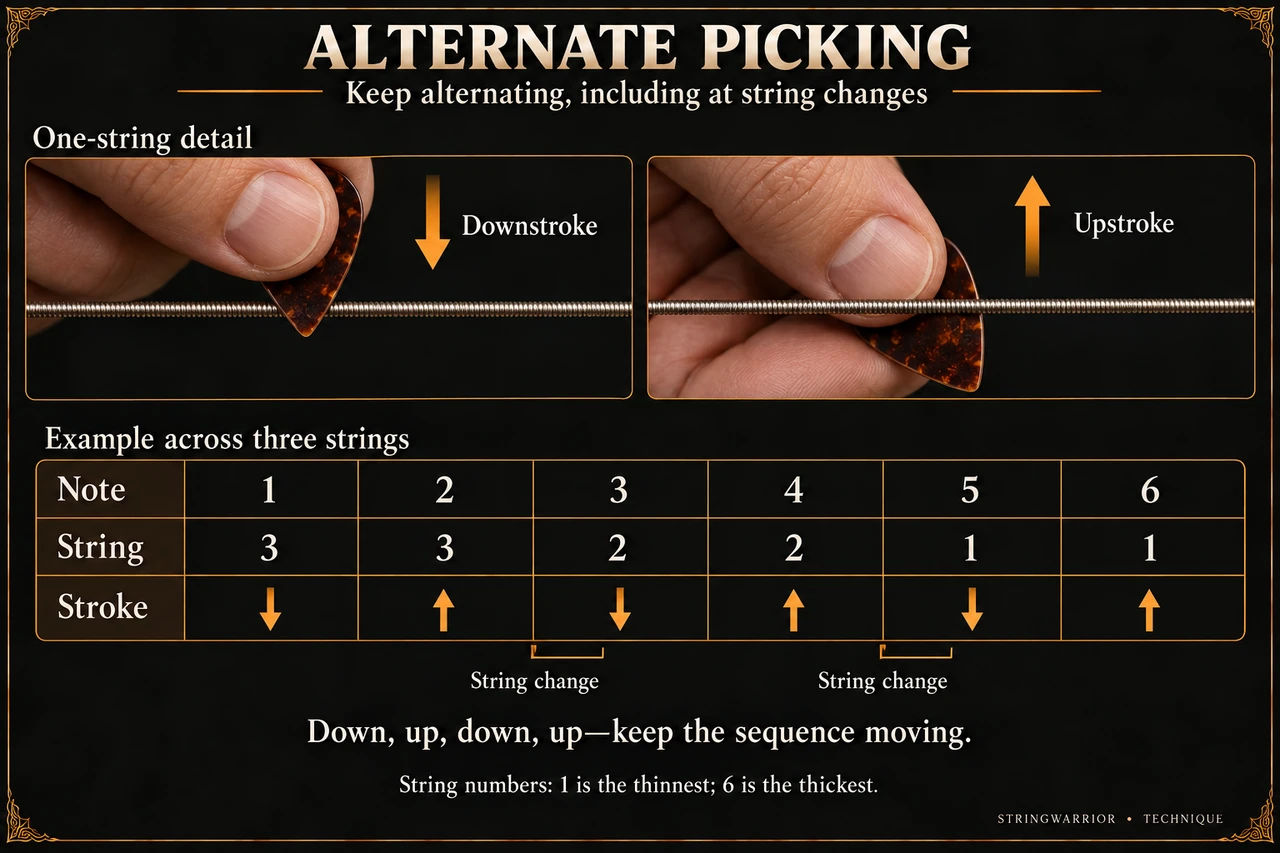
Alternate picking is the habit of strictly alternating your pick direction: every downstroke is followed by an upstroke and every upstroke by a downstroke, with exactly one pick stroke per note. Instead of deciding how to attack each note as it comes, you let a steady down-up-down-up motion run in your picking hand while your fretting hand supplies the actual notes.
It is easiest to understand next to the alternatives. Playing everything with downstrokes is punchy but slow and tiring; economy picking reuses a stroke direction on string changes to save motion. Alternate picking sits between them — it gives up a little efficiency when you cross strings in exchange for a symmetrical, metronomic motion that stays even and scales all the way up to very fast tempos.
This is the default technique for single-note playing: scales, riffs, and melodic runs in rock, metal, country, jazz, and the flatpicking that drives bluegrass. Because the hand never stops moving, alternate picking also becomes a built-in clock — the downstrokes tend to fall on the beat and the upstrokes on the "and" in between.
How to play it
Everything about alternate picking comes down to a small, relaxed, repeatable motion. Build it slowly and it becomes automatic; rush it and you build in tension you will later have to unlearn.
Hold the pick loosely
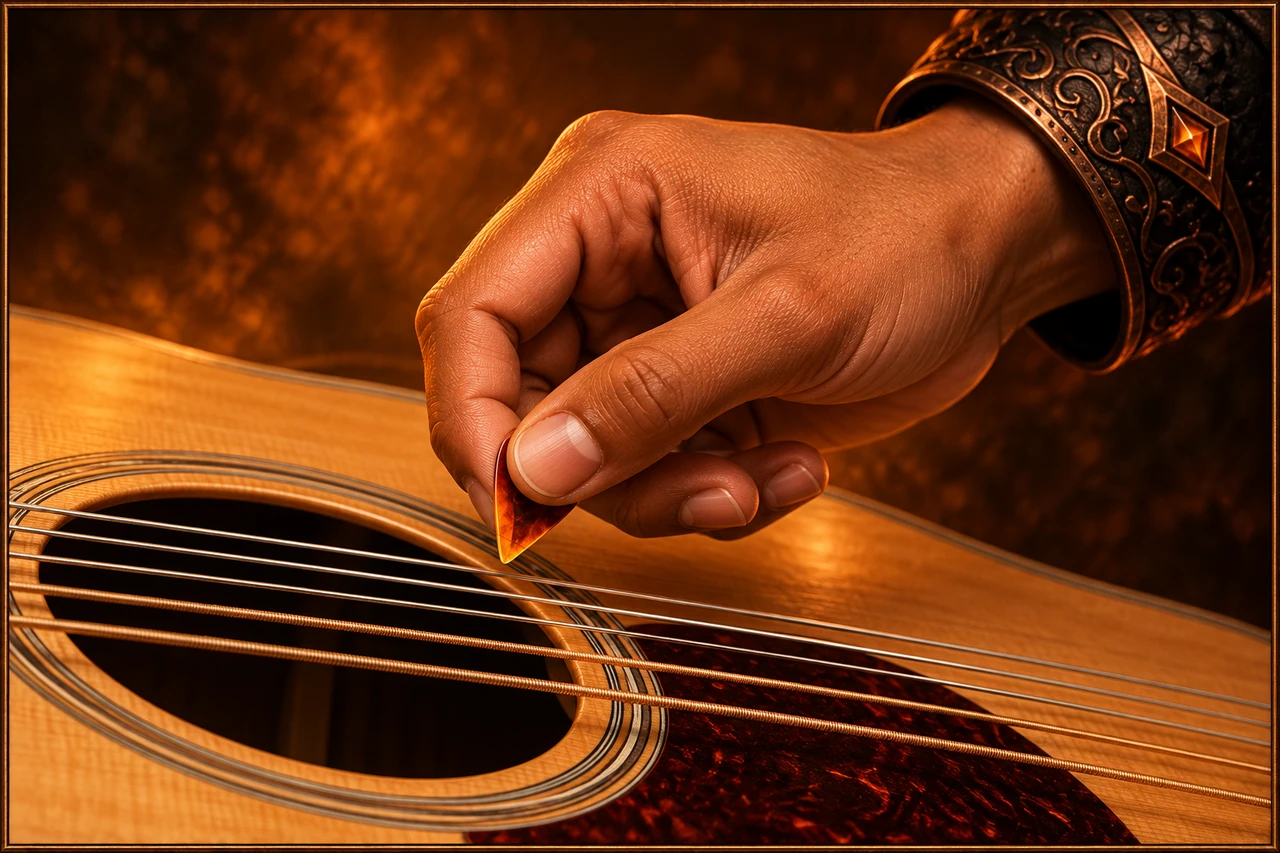
Grip the pick between the pad of your thumb and the side of your index finger, with only a few millimetres of tip showing. A relaxed hold that lets the pick flex slightly glides over the strings; a white-knuckle grip snags them.
Move from the wrist
The stroke comes from a small rotation of the wrist and forearm, not from big finger flicks or a swinging elbow. Think of shaking a drop of water off your fingertip, or turning a key — a compact, low-effort motion.
Keep the strokes small
The pick should travel just past the string and no further. The less distance it covers on each stroke, the faster and cleaner you can alternate. Big "swiping" strokes are the number-one thing that caps your speed.
One stroke per note
Say "down, up" out loud as you play. The instant a note sounds, the pick is already moving toward the next stroke. Never let the pick stop and rest on a string between notes.
Start on a single string so the only variable is the picking motion. This chromatic warm-up on the low E string is pure down-up — pick it strictly D U D U D U D U and keep every note the same length and volume:
e|----------------------------------
B|----------------------------------
G|----------------------------------
D|----------------------------------
A|----------------------------------
E|---5---6---7---8---8---7---6---5--
Once that feels even, the real test is holding the alternation while you change strings. Do not let a string change reset your motion: if the last note was an upstroke, the first note on the new string is a downstroke, every time.
Common mistakes
- Chasing speed too early: tension and sloppiness learned fast are hard to undo. Play at the fastest tempo where every note is clean, and no faster.
- Death-gripping the pick: a tight grip and a locked wrist kill both speed and tone. Loosen your hand until the pick almost feels like it could slip.
- Hands out of sync: if fret and pick do not land together you get ghost notes and flubs. Slow down until the two hands click on every single note.
- Breaking the alternation on string changes: sneaking in two downstrokes to make a crossing easier is really economy picking. That is a valid technique, but keep it separate while you are drilling strict alternate picking.
- Big, wide strokes: if the pick swings far away from the strings between notes, your ceiling stays low. Shrink the motion.
Practice drills
These are original drills, not song excerpts — build them with a metronome and only nudge the tempo up once a speed feels effortless. If any symbol is unfamiliar, read our guide to reading tab first.
1. String-crossing chromatic (finger independence)
Play frets 5-6-7-8 on the low E, A, and D strings in turn, strictly D U D U throughout. The goal is to cross to the next string without hesitating or dropping the alternation:
e|--------------------------------------------------
B|--------------------------------------------------
G|--------------------------------------------------
D|-----------------------------------5---6---7---8--
A|-------------------5---6---7---8------------------
E|---5---6---7---8----------------------------------
2. Two notes per string (outside & inside picking)
Two notes on each string forces a pick change on every crossing — the hardest thing to keep clean. This is an ascending A minor pentatonic shape; keep it slow until each string change is seamless:
e|-----------------------------------5---8--
B|---------------------------5---8----------
G|-------------------5---7------------------
D|-----------5---7--------------------------
A|---5---7----------------------------------
E|------------------------------------------
3. Pentatonic descending run (put it together)
The payoff drill: a descending A minor pentatonic line at two notes per string. Once this flows evenly with the metronome, you have a fast, usable lead lick:
e|---8---5------------------------------------------
B|-----------8---5----------------------------------
G|-------------------7---5--------------------------
D|---------------------------7---5------------------
A|-----------------------------------7---5----------
E|-------------------------------------------8---5--
For structured routines that build picking speed over weeks, head to guided practice, and browse the tab-driven guitar licks and guitar exercises to apply alternate picking to real phrases.
When to use it
Reach for alternate picking any time you are playing single notes and want speed, evenness, and endurance: scale runs, single-note riffs, melodies, and fiddle-style tunes. It is the workhorse behind most lead guitar and the foundation you build other picking approaches on top of.
It is not the only answer. Smooth, connected phrases often sound better with hammer-ons and pull-offs, which let you skip picking some notes entirely, and one-directional arpeggios are more efficient with economy and sweep picking. Strong players mix all of these; alternate picking is just the reliable default. Explore the whole toolkit on the techniques hub, and put your picking to work on real material in the songbook and the step-by-step learn path.
Related on String Warrior
Take alternate picking to the fretboard:
Alternate Picking FAQ
- What is alternate picking on guitar?
- Alternate picking means strictly alternating your pick direction — down, up, down, up — with one pick stroke per note, whichever string you are on. The constant, symmetrical motion keeps the picking hand relaxed and even, and that is what makes fast, clean single-note lines possible.
- Is alternate picking better than economy picking?
- Neither is better; they solve different problems. Alternate picking gives a metronomic, symmetrical motion that shines on scales and riffs, while economy picking is more efficient when you cross strings. Most players build strict alternate picking first, then add economy picking for specific runs.
- How do I get faster at alternate picking?
- Speed comes from clean, relaxed repetition, not force. Practise with a metronome, start slow enough to play every note perfectly in time, keep the pick strokes small, and only raise the tempo a few BPM at a time once the current speed feels effortless.
- Which instruments use alternate picking?
- Guitar, bass, and mandolin all rely on alternate picking for single-note playing. The down-up motion transfers directly between them, with small adjustments for string spacing and pick angle.