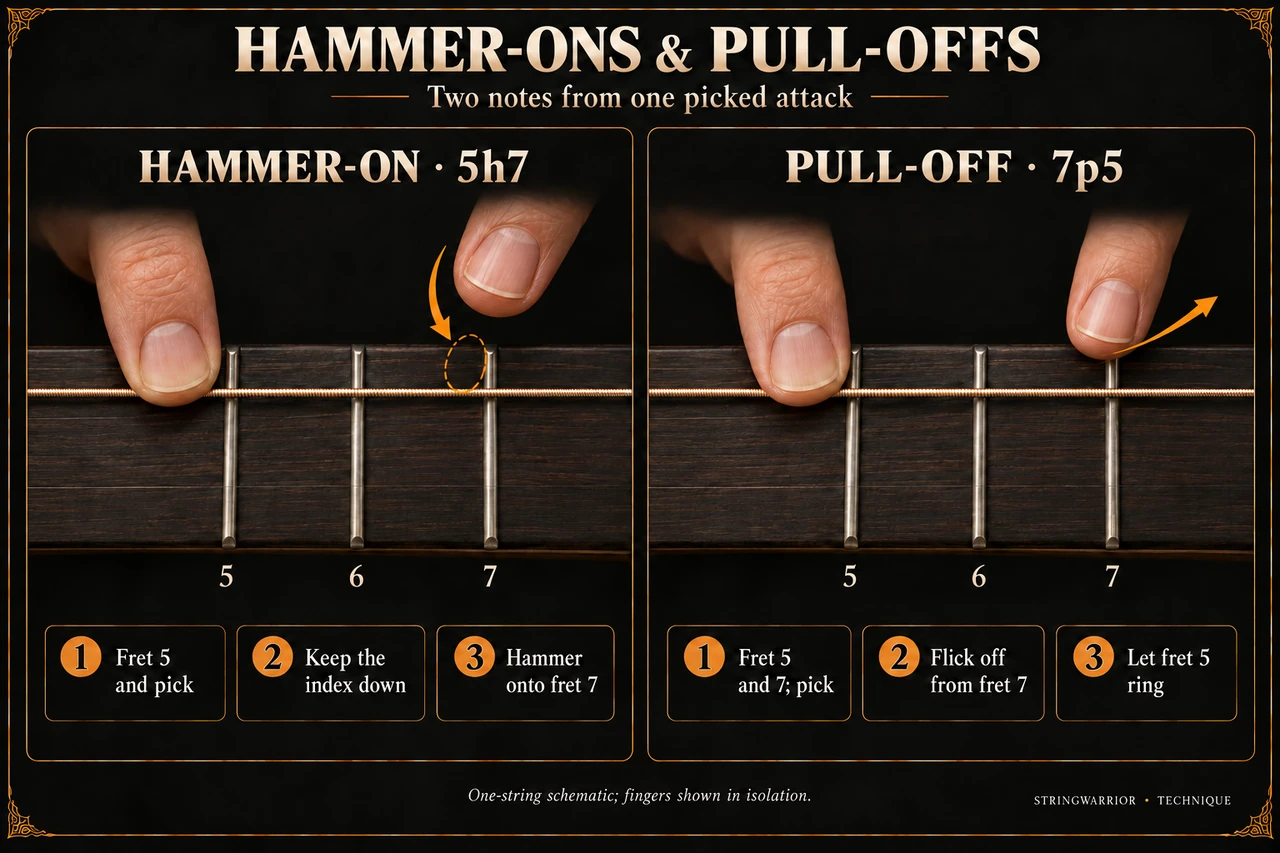
What hammer-ons & pull-offs is
Hammer-ons and pull-offs are the two halves of legato — the art of sounding notes with your fretting hand alone, without picking each one. A hammer-on raises the pitch: you strike a fretting finger down onto a higher fret hard enough that the string rings on its own. A pull-off lowers it: you pluck the string with a fretting finger as you lift it away, sounding a lower fretted note or the open string underneath. String them together and a whole run flows out of a single pick attack.
In tab they are written with a lowercase h and p between the fret numbers. 5h7 means "pick fret 5, then hammer onto fret 7"; 7p5 means "pick fret 7, then pull off to fret 5." You only ever pick the note before the letter — everything after it is your fretting hand doing the work. That is the whole point: fewer pick strokes, smoother lines, more speed for less effort.
When to use it
Legato earns its keep in three places. First, speed and fluidity: a fast run played mostly with hammers and pull-offs needs only a handful of pick strokes, so your two hands do not have to stay in perfect lockstep — the reason so many quick rock and blues licks are legato. Second, phrasing: because the connected notes have no fresh pick attack, the line sounds smooth and vocal, ideal for melodies, grace notes, and ornaments. Third, trills — rapidly repeating a hammer-on and pull-off between two frets — which add sustain and shimmer to a held note. It is also the natural way to embellish a chord, hammering a decorated note in without lifting your strumming hand.
Examples in tab
These examples are original exercises in standard tab. Only the fret before each h or p is picked — every other note comes from the fretting hand.
Example 1 — The two core moves. On the B string, pick fret 5 and hammer onto fret 8; then pick fret 8 and pull off to fret 5. One is the hammer, one is the pull-off — learn to make both ring as loudly as a picked note before moving on.
e|---------------------
B|--5h8------8p5-------
G|---------------------
D|---------------------
A|---------------------
E|---------------------
Example 2 — Ascending legato run (A minor pentatonic). Pick only the first note on each string and hammer the second. Six pick strokes give you twelve notes — that efficiency is what legato buys you.
e|----------------------5h8--
B|------------------5h8------
G|--------------5h7----------
D|----------5h7--------------
A|------5h7------------------
E|--5h8----------------------
Example 3 — Descending pull-off run. The same box coming back down. Fret both notes first, pick the higher one, then pull off. Pull through the string, do not just lift.
e|--8p5----------------------
B|------8p5------------------
G|----------7p5--------------
D|--------------7p5----------
A|------------------7p5------
E|----------------------8p5--
Example 4 — Trill for endurance. Hold fret 7 on the G string and trill to fret 9: hammer, pull, hammer, pull, as evenly and as long as you can. This is the single best strength-and-stamina drill for both moves.
e|-----------------------
B|-----------------------
G|--7h9p7h9p7h9p7h9p7-----
D|-----------------------
A|-----------------------
E|-----------------------
How to play it
Both moves live in the fingertips. Set them up like this and they come together fast.
The hammer-on
Strike your fretting finger straight down onto the string like a tiny hammer, landing right behind the fret wire. The power comes from the finger's own snap, not from your arm. Aim for a firm, decisive hit — a timid tap will not ring.
The pull-off
Do not simply lift the finger — that just stops the note. Instead, pluck the string slightly sideways (down toward the floor) as you release, so your fingertip flicks it on the way off. Have the lower target note already fretted so it is ready to sound.
Land close to the fret
Both hits want to be just behind the fret wire, where the least pressure gives the cleanest note. Land too far back toward the middle of the fret and you get a dull, buzzy, quiet result no matter how hard you try.
Stay relaxed
Keep your thumb loose behind the neck and your other fingers curled and close to the strings. Squeezing the neck tires you out and makes fast legato impossible. Small, economical motions win.
Build it up in four steps — do not rush past a stage until it is clean and even against a metronome:
- Single moves. Just Example 1: one hammer-on, one pull-off, over and over, until each sounds as strong as a picked note.
- Runs. Examples 2 and 3 — one pick per string, ascending then descending, slowly and evenly.
- Trills. Example 4 for finger strength and stamina; stop the moment the notes get uneven, rest, and go again.
- In context. Drop legato into real phrases from the guitar licks and guitar exercises libraries.
Common mistakes to watch for:
- Weak, quiet hammered notes. You are hitting too softly or too far from the fret — hammer harder and land right behind the wire.
- Silent pull-offs. You are lifting straight up instead of plucking sideways. Give the string a little downward flick as the finger leaves it.
- Forgetting to pre-fret. A pull-off has nothing to sound into unless the lower note is already held down (or it is an open string). Set it before you pull.
- Picking the second note by habit. If you pick the hammered note you have lost the legato. Let the fretting hand alone sound everything after the first pick.
Related on String Warrior
Take hammer-ons & pull-offs to the fretboard:
- All guitar techniques
- Slides — the other main way to connect notes legato
- Alternate picking — the picking-hand counterpart for fast runs
- Tapping — hammer-ons and pull-offs taken to the picking hand
- Vibrato — add expression once your legato lines ring cleanly
- Guitar licks and guitar exercises to drill it in context
- Guided practice routines, songs to play, and the Learn path for beginners
- How to read tab, including the h and p symbols
Hammer-ons & Pull-offs FAQ
- What is the difference between a hammer-on and a pull-off?
- A hammer-on raises the pitch: you strike a fretting finger down onto a higher fret so the string rings without being picked. A pull-off lowers it: you pluck the string sideways with a fretting finger as you lift it, sounding a lower fretted note or the open string. One goes up, one comes down, and neither uses the picking hand.
- Why don't my hammer-ons and pull-offs make a sound?
- Almost always one of three things. Hammer harder and land right behind the fret wire, not in the middle of the fret. For pull-offs, flick the string slightly downward as your finger leaves it instead of lifting straight up. And make sure the lower note of a pull-off is already fretted so it has something to ring into.
- Do I pick the second note of a hammer-on?
- No — that is the whole idea. You pick only the first note of a legato group; every note after an h or p is sounded by the fretting hand alone. If you pick the hammered or pulled note you have turned it back into an ordinary picked note and lost the smooth, connected legato sound.
- What instruments do hammer-ons and pull-offs work on?
- Guitar, bass, ukulele, and mandolin — any fretted string instrument. Electric guitar is the easiest because light strings and amplification make the notes ring with little effort; on acoustic and bass you simply hit a little firmer to get the same volume.