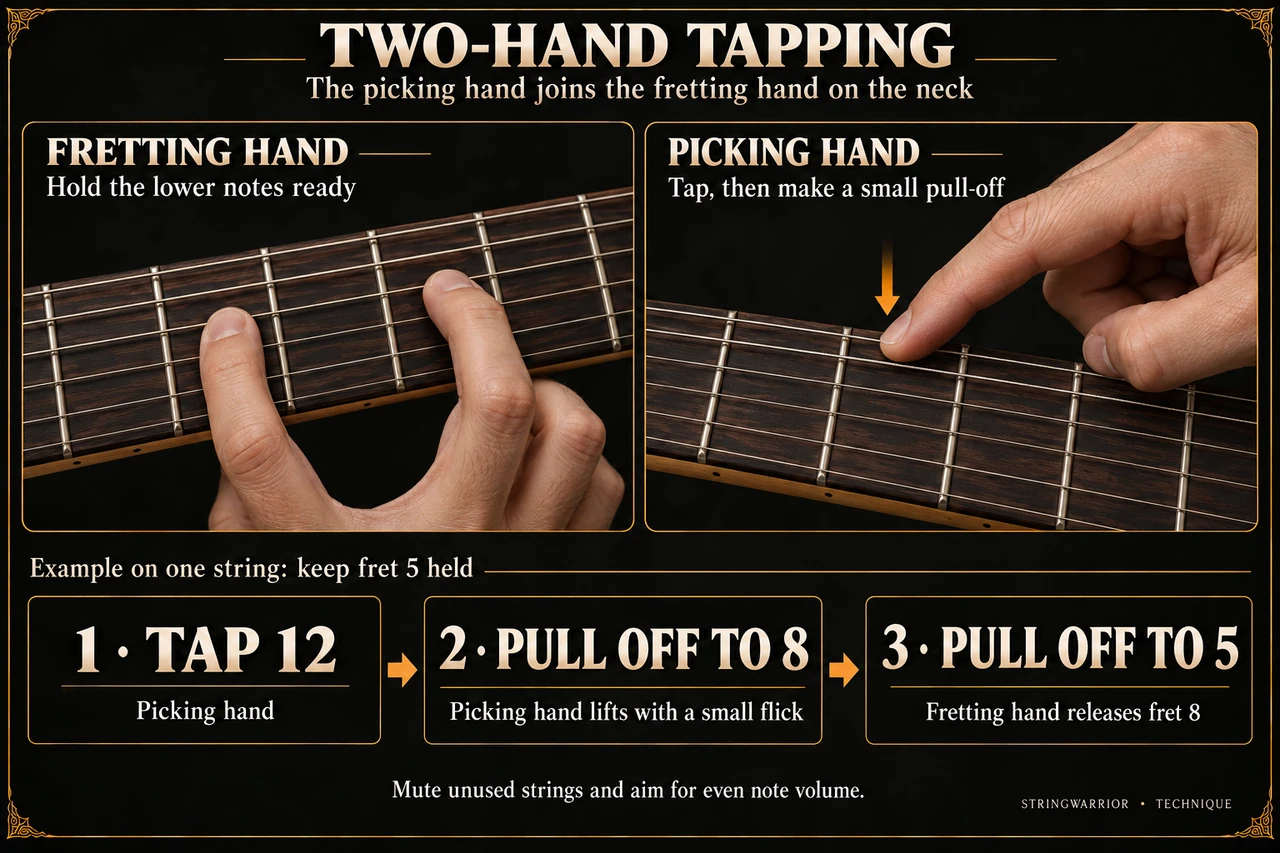
What tapping is
Tapping is a legato technique that puts your picking hand to work on the fretboard. Instead of picking a string, you reach over the neck and hammer a finger of your picking hand straight down onto a fret, sounding the note exactly the way a fretting-hand hammer-on does. Because both hands are now fretting, you can play notes that sit impossibly far apart for one hand alone — a low note held by the fretting hand and a high note tapped a dozen frets away, all ringing together.
It is really just hammer-ons and pull-offs shared between two hands. You tap a high note, pull off to a note your fretting hand is already holding, hammer to another, and repeat — a rolling stream of pitches from a single tap attack. On this page a tapped note is written with a t before the fret (t12 means "tap fret 12"), alongside the usual h for a hammer-on and p for a pull-off. That t12p5h8 group is the seed of nearly every tapping lick: tap fret 12, pull off to fret 5, hammer to fret 8, over and over.
When to use it
Tapping shines whenever you want speed with wide intervals. A tapped arpeggio can span two octaves on a single string, giving the cascading, harp-like runs that sweep or alternate picking would struggle to reach. It is the signature sound of flashy rock and metal lead playing, but it is just as at home adding a bright, ringing top note to a held chord, or letting one hand keep a bass line going while the other taps a melody above it. Anywhere a phrase needs notes farther apart than one hand can stretch, tapping is the answer — and once the motion is clean, it is one of the easiest ways to play very fast, because the picking hand does so little work per note.
Examples in tab
These are original exercises in standard tab. Read t as "tap with a picking-hand finger," h as a fretting-hand hammer-on, and p as a pull-off. Your fretting hand holds the two lower notes down the whole time; the tap and pull-off do the rest without a single pick stroke.
Example 1 — The core tapping unit. On the high E string, hold fret 5 with your first finger and fret 8 with your third or fourth. Tap fret 12, pull off to 5, hammer to 8, and repeat. Those three notes (E, A, C) spell an A minor arpeggio — the rolling triplet that launched a thousand solos.
e|--t12p5h8--t12p5h8--t12p5h8--t12p5h8--
B|--------------------------------------
G|--------------------------------------
D|--------------------------------------
A|--------------------------------------
E|--------------------------------------
Example 2 — Move the tapped note. Keep frets 5 and 8 held and walk the tapping finger up the string. The bottom two notes stay put while the top note climbs, turning the same shape into a melody.
e|--t12p5h8--t15p5h8--t17p5h8--t15p5h8--
B|--------------------------------------
G|--------------------------------------
D|--------------------------------------
A|--------------------------------------
E|--------------------------------------
Example 3 — The wide reach. This is what tapping buys you that one hand cannot. Pick fret 5, hammer to 8, then tap all the way up at fret 17 (an octave above the 5) and pull back down. Feel how far apart the hands are — that stretch is impossible without the second hand.
e|--5h8t17p8p5--5h8t17p8p5--
B|--------------------------
G|--------------------------
D|--------------------------
A|--------------------------
E|--------------------------
Example 4 — Pedal-tone tapping. Tap fret 15 as a ringing pedal while the fretting hand walks a descending line underneath it. The steady high note over the moving bottom notes gives a shimmering, music-box texture.
e|--t15p8--t15p7--t15p5--t15p3--
B|------------------------------
G|------------------------------
D|------------------------------
A|------------------------------
E|------------------------------
How to play it
A tap is just a hammer-on thrown by the wrong hand. Set it up like this and the motion comes together fast.
Tap like a hammer-on
Strike a picking-hand finger straight down onto the string, landing just behind the fret wire. Be firm and decisive — the note has to ring purely from the impact, so a timid tap will not sound. Most players tap with the index or middle finger.
Flick off to sound the pull
Do not simply lift the tapping finger — that just stops the note. Pull it slightly sideways, down toward the floor, as it leaves the string, so your fingertip flicks the string and the fretted note underneath rings out. A tap without a flicked pull-off is only half the move.
Park the pick
Keep a finger free without dropping the pick. Either tuck the pick into your palm and tap with your index finger, or keep gripping it and tap with your middle finger so you can go straight back to picking. Pick one and stick with it.
Kill the noise
Tapping wakes up every open string. Drape your fretting-hand fingers lightly across the strings you are not using and rest your picking-hand palm near the bridge, so only the note you want rings and the rest stays silent.
Build it up in four steps — do not move on from a stage until it is clean and even against a metronome:
- One tap. Just tap fret 12 with no pick and get a clean, loud note. If it is quiet, tap harder and land closer to the fret.
- The unit. Example 1, tap-pull-hammer, slowly and evenly, until all three notes are equally loud.
- Moving notes. Examples 2 and 4, changing one note at a time so the shape becomes a melody.
- In context. Example 3's wide reach, then drop tapping into real phrases from the guitar licks and guitar exercises libraries.
Common mistakes to watch for:
- Weak, quiet tapped notes. You are tapping too softly or too far from the fret — hit harder and land right behind the wire.
- Silent pull-offs. You are lifting straight up instead of flicking. Pull the tapping finger sideways as it leaves so the fretted note re-sounds.
- Open-string squeal and racket. You are not muting. Rest idle fretting fingers and your picking-hand palm across the strings to keep everything else quiet.
- Fretted notes drifting. Keep the fretting-hand fingers planted for the whole lick so the hammered and pulled notes are always ready to ring.
Related on String Warrior
Take tapping to the fretboard:
- All guitar techniques
- Hammer-ons & pull-offs — the fretting-hand version to master first; tapping is the same move in the other hand
- Economy & sweep picking — the other route to fast, fluid arpeggios
- String & fretting-hand muting — the noise control that keeps tapped licks clean
- Guitar scales and guitar chords for the arpeggio shapes tapped licks are built from
- Guitar licks and guitar exercises to drill it in context
- Guided practice routines, songs to play, and the Learn path for beginners
- How to read tab, including the h and p symbols
Tapping FAQ
- Is tapping hard to learn?
- The motion itself is simple — a tap is just a hammer-on thrown by your picking hand, so if you can hammer-on you already have the core move. The genuinely tricky part is muting the strings you are not tapping, because both hands are busy and open strings ring easily. Start slowly, keep every note clean, and add speed only once it is quiet.
- Do I need an electric guitar or distortion to tap?
- No. Distortion adds sustain that makes tapped notes ring with the least effort, which is why the technique is associated with electric lead playing, but it is not required. Tapping works fine on a clean electric, on an acoustic if you tap a little firmer, and on bass. It is the technique that matters, not the gain.
- What finger should I tap with?
- Most players tap with the index or the middle finger of the picking hand. If you tap with your index, tuck the pick into your palm first; if you tap with your middle finger, you can keep holding the pick and drop straight back into normal picking. Pick whichever feels natural and stay consistent.
- Can you tap on acoustic guitar or bass?
- Yes. On acoustic you simply tap harder, since there is no amp to help the note sustain. Bass is a natural fit — its long scale and wide string spacing make two-hand tapped lines ring out clearly, and tapping is a common way to play chords and melodies on it.