What string & fretting-hand muting is
Muting is the skill of silence — deliberately stopping strings from sounding so that only the notes you want come through. It is the difference between a clean, professional-sounding part and a wash of ringing, buzzing noise. Where palm muting chokes a note that still sounds its pitch, general muting kills the pitch entirely: an unwanted open string, the strings on either side of the one you are picking, or the gaps between notes in a tight funk rhythm.
You mute with both hands. The fretting hand lightly touches strings — either the one you are playing (to cut it short) or the ones next to it (to keep them quiet). The picking hand lets the side of the palm rest across the lower strings you are not sounding. Good players do this constantly and unconsciously; it is what lets a distorted riff or a fast lead line stay articulate instead of turning to mud.
When to use it
Muting shows up in three main places. Clean single-note lines: when you pick one string, the strings around it want to ring in sympathy, so you damp them to keep the line clear. Dead notes and funk scratch: resting your fretting fingers flat and strumming produces the percussive "chick" (written x) that drives funk, R&B, reggae, and disco rhythm guitar. Stopping and starting: muting the strings ends a note or a chord exactly when you want silence, giving your playing punctuation and groove instead of one long blur.
Examples in tab
A note on audio: our engine plays clean plucked notes, so it cannot reproduce a muted, pitchless click or the silence between notes — muting is a physical motion, not a pitch. The tab below is a visual reference: read it and hear the difference on your own instrument.
These examples are original and use standard tab. An x is a dead note — rest a fretting finger across the string without pressing it to a fret, then pick or strum.
Example 1 — Funk scratch. Lay your fretting-hand fingers flat across the strings without pressing to a fret, then strum steady sixteenths. Every hit is a dead, percussive click — the foundation of funk and reggae rhythm.
e|-x-x-x-x-x-x-x-x-
B|-x-x-x-x-x-x-x-x-
G|-x-x-x-x-x-x-x-x-
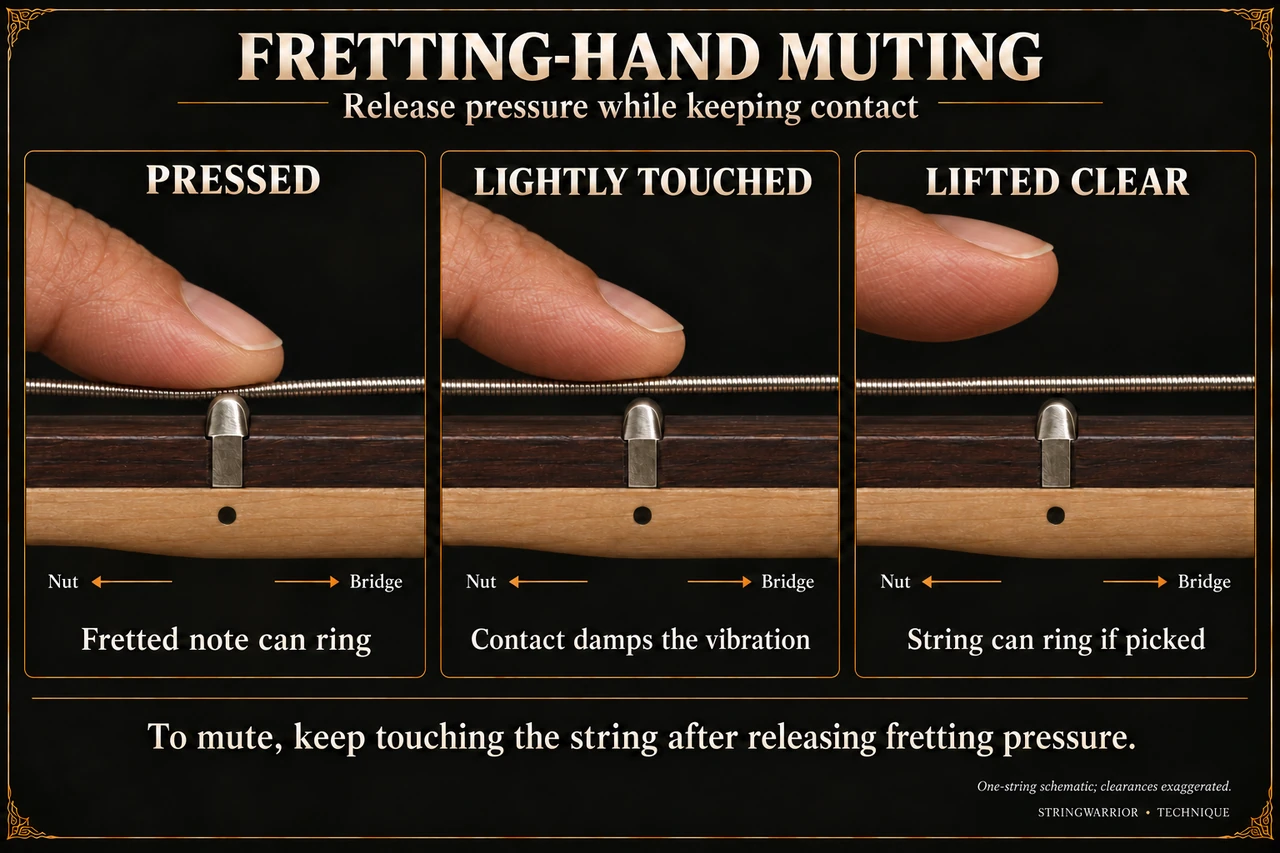
Example 2 — Staccato single notes. Play a note, then relax the fretting finger (still touching the string) to choke it into a dead click before the next note. That tight, clipped feel is pure funk and R&B.
E|--3--x--5--x--7--x--5--x--Example 3 — Silence around a lead line. No x marks here — the whole point is the strings that stay quiet. Play this on the G string only, letting your picking-hand palm damp the lower strings (E, A, D) and your fretting fingers lean against the higher ones (B, e), so nothing but the G rings.
e|------------------
B|------------------
G|--5--7--5--4------
D|------------------
A|------------------
E|------------------
How to play it
Muting is really four small habits working together:
Fretting-hand damping
To stop a note ringing, just relax the pressure — keep your finger touching the string but stop pressing it to the fret. The pitch dies instantly. This is how you get crisp, staccato notes and clean stops.
Picking-hand palm damping
Rest the side of your picking-hand palm lightly across the lower strings you are not playing. On a bass or a low riff this kills the boom from open strings you are not using.
Dead notes (x)
Lay one or more fretting fingers flat across the strings without pressing to a fret, then pick or strum. You get a pitchless, percussive click — the building block of scratch rhythm.
Both hands as a cage
For a single clean note, surround it with silence: fretting fingers lean into the strings above the note, palm damps the strings below it. Only the target string is free to ring.
Build it slowly. Practise the scratch groove in Example 1 against a metronome, keeping your strumming hand moving in even sixteenths while your fretting hand only relaxes and re-grips. Then play a simple scale on one string and concentrate on keeping every other string silent.
Common mistakes to watch for:
- Pressing instead of resting. A dead note comes from touching, not fretting. If you hear a pitch on your x notes, ease off until the string only clicks.
- Muting with one hand only. Fast, clean lines almost always need both hands damping at once — the palm below, the fingers above.
- Stopping your strumming hand. In funk scratch the strumming hand never stops moving; you mute by releasing finger pressure, not by freezing the strum.
- Letting open strings bleed through. When you jump strings, the one you just left keeps ringing — train a finger or the palm to fall onto it as you move.
Related on String Warrior
Put muting to work across your playing:
- All guitar techniques
- Palm muting — the picking-hand cousin that chokes a note without killing its pitch
- Strumming — where scratch rhythms and dead-note grooves live
- Strumming trainer — practise scratch and dead-note patterns in time
- Guitar scales and guitar licks to drill clean single-note lines
- Guitar exercises, guided practice routines, and songs to play
- How to read tab, including the x dead-note symbol
String & Fretting-Hand Muting FAQ
- What is the difference between palm muting and string muting?
- Palm muting is one specific move: the picking-hand palm resting at the bridge to choke the ring while the note still sounds its pitch. String or fretting-hand muting is the broader skill of silencing strings entirely so they make no pitch at all, using either hand to stop unwanted noise.
- How do I stop other strings from ringing when I play single notes?
- Use both hands. Let the side of your picking-hand palm rest lightly on the lower strings you are not playing, and let the underside of your fretting fingers lean against the higher strings. Only the string you pick is left free to ring.
- What do the x marks in tab mean?
- An x is a dead or muted note: you rest a fretting-hand finger across the string without pressing it to a fret, then pick it. The result is a percussive, pitchless click used for rhythmic accents, especially in funk and rock.
- How do I get a clean funk scratch rhythm?
- Lay your fretting-hand fingers flat across the strings without pressing to a fret, keep your strumming hand moving in steady sixteenth notes, and release finger pressure between chords so the in-between strums come out as dead scratches. Consistent motion matters more than force.