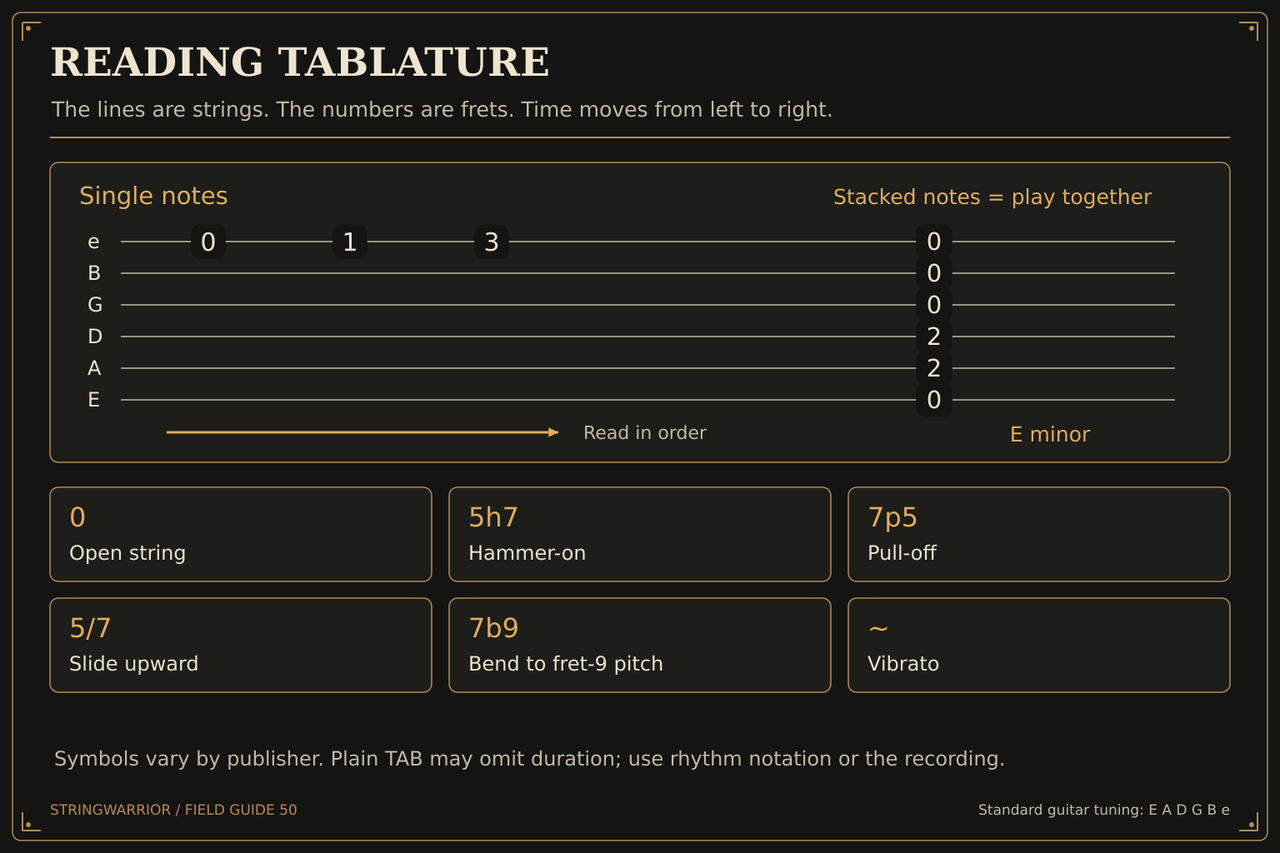
The six lines are your strings
A tab staff is a set of horizontal lines, one per string. For guitar there are six lines; bass uses four, ukulele uses four, and mandolin uses four (doubled) strings. The bottom line is your lowest-pitched string and the top line is your highest-pitched string — the same order as looking down at the strings while you play.
For a guitar in standard tuning, that looks like this from top to bottom:
e|---------------
B|---------------
G|---------------
D|---------------
A|---------------
E|---------------
Those letters at the left are the open-string names, low E on the bottom to high e on top. If you play a different tuning, the letters change but the layout doesn't — check your current tuning any time on the tuner.
The numbers are frets
A number written on a line tells you which fret to press on that string. 0 means play the string open — don't press any fret at all. Read the tab left to right, just like reading a sentence, and play each number in order.
e|---0---1---3---
B|---------------
G|---------------
D|---------------
A|---------------
E|---------------
That example plays three notes on the high e string: open, 1st fret, then 3rd fret. When two numbers stack on top of each other in the same column, play both strings together as a chord or double-stop.
Tab tells you exactly where to put your fingers, but it doesn't usually show rhythm. Many tabs pair the fret numbers with rhythm notation above them, or you'll pick up the timing by ear from a recording. If you're starting from nothing, our chord library and scale library are good places to build the shapes tab keeps referring to.
The technique symbols
Once you're comfortable with lines and numbers, the next layer is a small set of letters and symbols that tell you how to play a note, not just where. You'll see these constantly in licks and solos.
h — hammer-on
Pick the first note, then "hammer" a left-hand finger onto a higher fret without picking again. 5h7 means pick fret 5, then hammer onto fret 7.
p — pull-off
The reverse of a hammer-on. Pick a fretted note, then pull your finger off to sound a lower fret (or the open string) without a second pick stroke. 7p5 picks fret 7, then pulls off to fret 5.
b — bend
Push or pull the string across the fret to raise its pitch. 7b9 means fret 7, bent up until it sounds like fret 9. A "full bend" usually raises the pitch a whole step.
sl, / and \ — slide
Pick a note, then slide your finger along the string to a new fret without lifting off. A forward slash / slides up in pitch, a backslash \ slides down. 3/5 slides from fret 3 up to fret 5.
x — muted or dead note
A percussive, pitchless "click" made by resting a left-hand finger on the string (without pressing a fret) and picking it anyway. Great for rhythmic accents, especially in rock and funk.
~ or v — vibrato
A wavy line or "v" after a note means wobble the pitch slightly and repeatedly with your fretting hand, adding warmth and sustain to a held note.
Put a few together and a real lick starts to look like this:
e|-----------------
B|-----------------
G|--7h9p7---7/9-----
D|-----------------
A|-----------------
E|-----------------
Read that as: on the G string, pick fret 7, hammer on to fret 9, pull off back to fret 7 — then later, pick fret 7 again and slide up to fret 9. Once you can say a tab out loud like that, you can play almost anything written this way.
Practicing with tab
Start slow — much slower than you think you need to. Read one small chunk (a beat or a bar) at a time, find the notes on your fretboard, and only speed up once your fingers know where to go without hesitating. It's completely normal to feel clumsy with hammer-ons and pull-offs at first; the coordination comes with repetition, not effort.
Real licks and short technique exercises are the best place to put this into practice. Every String Warrior instrument hub has a Licks section with tab-driven phrases and an Exercises section with focused technique drills — both display standard tab notation just like the examples above, so you can go straight from reading about tab to reading real tab.
Related on String Warrior
Now put tab reading to work on your instrument.