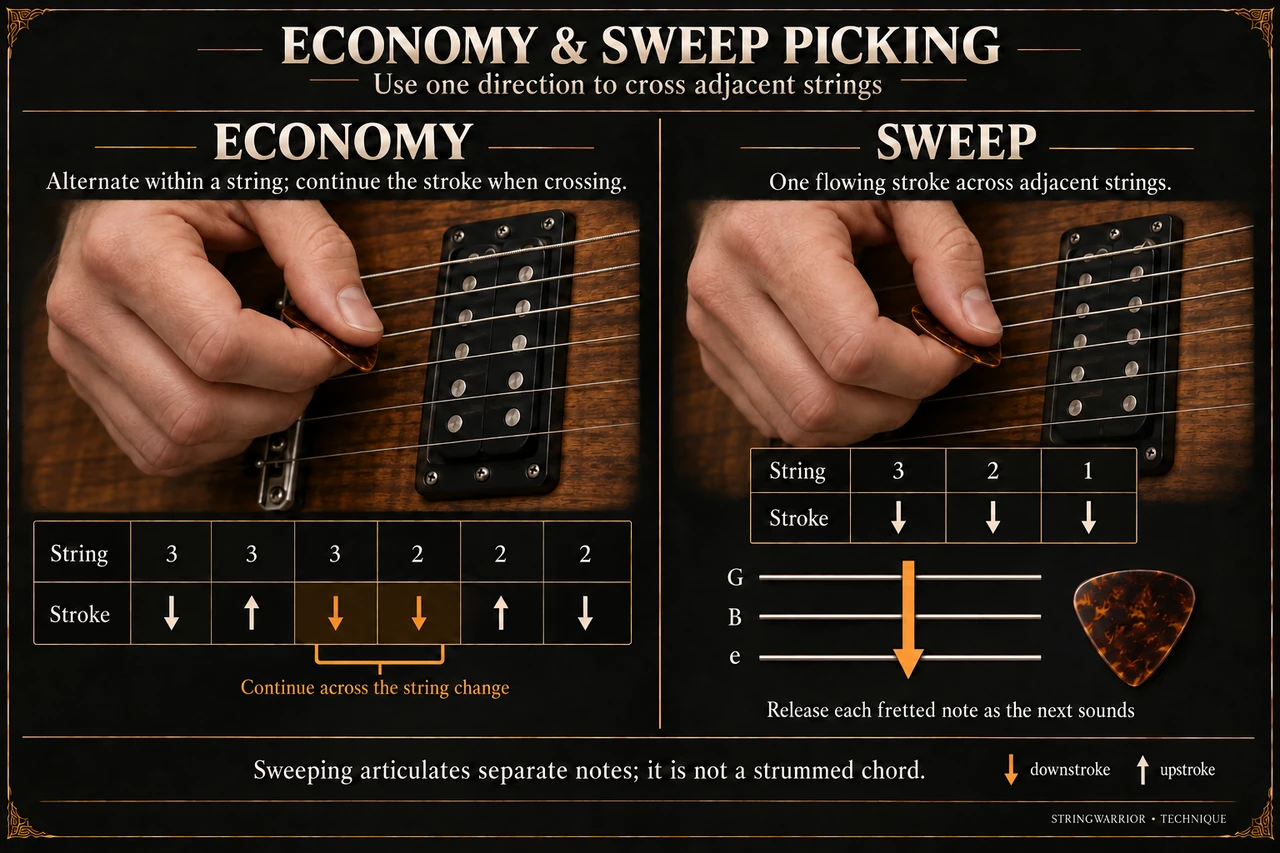
What economy & sweep picking is
Economy picking is a small change to the rules of alternate picking: instead of strictly flipping the pick on every note, you keep it moving in the same direction whenever that direction also carries you onto the next string. Crossing to a higher string right after a downstroke? Use another downstroke to fall onto it. Crossing to a lower string after an upstroke? Use another upstroke. Every saved motion is a little less work at speed.
Sweep picking is that same idea taken to its limit. Rather than picking each string of an arpeggio separately, you let the pick "sweep" through several strings in one continuous stroke — a single fluid downstroke to climb the arpeggio and a single upstroke to come back down — while your fretting hand rolls from string to string. Done well it sounds like a fast cascade of notes from almost no picking effort.
These are advanced lead techniques, most at home in rock, metal, and fusion, and they are what let players rip through arpeggios cleanly at high speed. They reward patience: the picking motion itself is easy, but coordinating it with the fretting hand so notes ring one at a time takes slow, careful practice.
How to play it
Two things make or break these techniques: keeping the picking stroke slow and even, and using the fretting hand to stop each note the instant the next one sounds. Get those and speed follows.
Sweep, don't pick
For a sweep, think of one smooth push of the pick through the strings — like dragging it across them in a single motion — not several fast separate strokes. Let a relaxed hand and the pick's own weight do the work.
Roll the fretting hand
The secret to a clean sweep is fret-hand muting: as each finger plays its note it lifts (while staying in contact to mute) so the previous string stops ringing. If a sweep sounds like a strummed chord, your notes are overlapping.
Sync the hands
The pick and the fretting finger must arrive at each string together. Practise so slowly that you can hear one clean, separate note per string — the whole point of the technique is clarity, not blur.
Feel the direction change
With economy picking the tricky moment is the consecutive same-direction stroke at a string change. Feel that "down-down" or "up-up" deliberately at first so it does not collapse back into alternate picking.
Start with pure economy picking on a scale, where only the crossings change. Here you play three notes on the G string, then three on the B string; the crossing from the last G-string note into the first B-string note is a consecutive downstroke — the economy move:
e|--------------------------
B|---------------5---6---8--
G|---5---7---9--------------
D|--------------------------
A|--------------------------
E|--------------------------
Pick it D U D — D U D: the two downstrokes in a row (the third G-string note and the first B-string note) are the whole point. Descending, you would flip it to U D U — U D U.
Common mistakes
- Letting the notes ring together: the biggest sweep-picking mistake. If you can hear a chord instead of separate notes, your fretting fingers are not lifting in time. Slow right down and mute each string as you leave it.
- Picking instead of sweeping: stabbing at each string with a fresh stroke defeats the purpose. Keep one continuous, gliding motion through the strings.
- Rushing the turnaround: the top and bottom of an arpeggio, where the sweep reverses direction, is where most players trip. Practise the change of direction on its own.
- Skipping the fundamentals: without solid alternate picking and hand sync underneath, sweeps stay messy. Build the basics first.
- Only training speed: a slow, perfectly clean sweep is worth ten fast, blurry ones. Clarity first, tempo later.
Practice drills
All original drills — build them slowly with a metronome and prize clean, separated notes over speed. New to tab? Start with how to read tab.
1. Three-string triad sweep
An A minor triad across the top three strings, up and back down. Sweep the pick down through the G, B, and high e strings, then up through e, B, and G — lifting each finger the moment the next note sounds:
e|----------12----------
B|------13------13------
G|--14--------------14--
D|----------------------
A|----------------------
E|----------------------
Picking: one continuous downstroke going up (G → B → e), one continuous upstroke coming back (e → B → G).
2. Five-string sweep arpeggio
The full move: a five-string A minor arpeggio. One relaxed downstroke rakes from the A string up to the high e, then one upstroke rakes back down. If it blurs into a chord, slow down and focus on the fret-hand roll:
e|------------------12------------------
B|--------------13------13--------------
G|----------14--------------14----------
D|------14----------------------14------
A|--12------------------------------12--
E|--------------------------------------
3. Economy scale runs
Take the three-note-per-string idea from the section above and run it up two or three strings in a row, always crossing with a same-direction stroke. This is where economy picking pays off in everyday scale playing — apply it to the shapes in the scale library.
Fold these into a routine on the practice page, and study how one-directional picking shows up in phrases across the guitar licks and guitar exercises collections.
When to use it
Economy and sweep picking earn their keep on arpeggios and one-directional runs — the moments where strict alternate picking would waste a motion on every string change. Sweep picking in particular is the go-to for fast, arpeggiated lead lines in rock, metal, and neoclassical styles.
They are specialists, not a replacement for the fundamentals. Learn clean alternate picking first — it builds the pick control everything else stands on — and combine these with tapping and hammer-ons and pull-offs for even wider, faster passages. Browse the full techniques hub, and put them to use on real material in the songbook and the guided learn path.
Related on String Warrior
Take economy & sweep picking to the fretboard:
Economy & Sweep Picking FAQ
- What is the difference between economy picking and sweep picking?
- They are the same idea at different scales. Economy picking reuses a pick stroke whenever you cross to an adjacent string in the same direction, saving a motion. Sweep picking extends that into one continuous stroke that rakes across several strings, usually to play an arpeggio.
- Is sweep picking hard to learn?
- The picking motion is simple — a slow, even rake — but the hard part is the fretting hand. Each finger has to fret its note and lift off immediately so the strings never ring together into a chord. Practise it slowly and cleanly; speed is the last thing you add.
- Should I learn alternate picking before sweep picking?
- Yes. Alternate picking builds the pick control, timing, and hand synchronisation that economy and sweep picking depend on. Get comfortable with clean alternate picking first, then reach for economy and sweep picking on the arpeggios and one-directional runs where they are more efficient.
- Which instruments use economy and sweep picking?
- These are guitar techniques, most common in rock, metal, and fusion lead playing. The one-directional picking idea can be applied on any plucked string instrument, but the classic arpeggio sweeps are written for guitar.