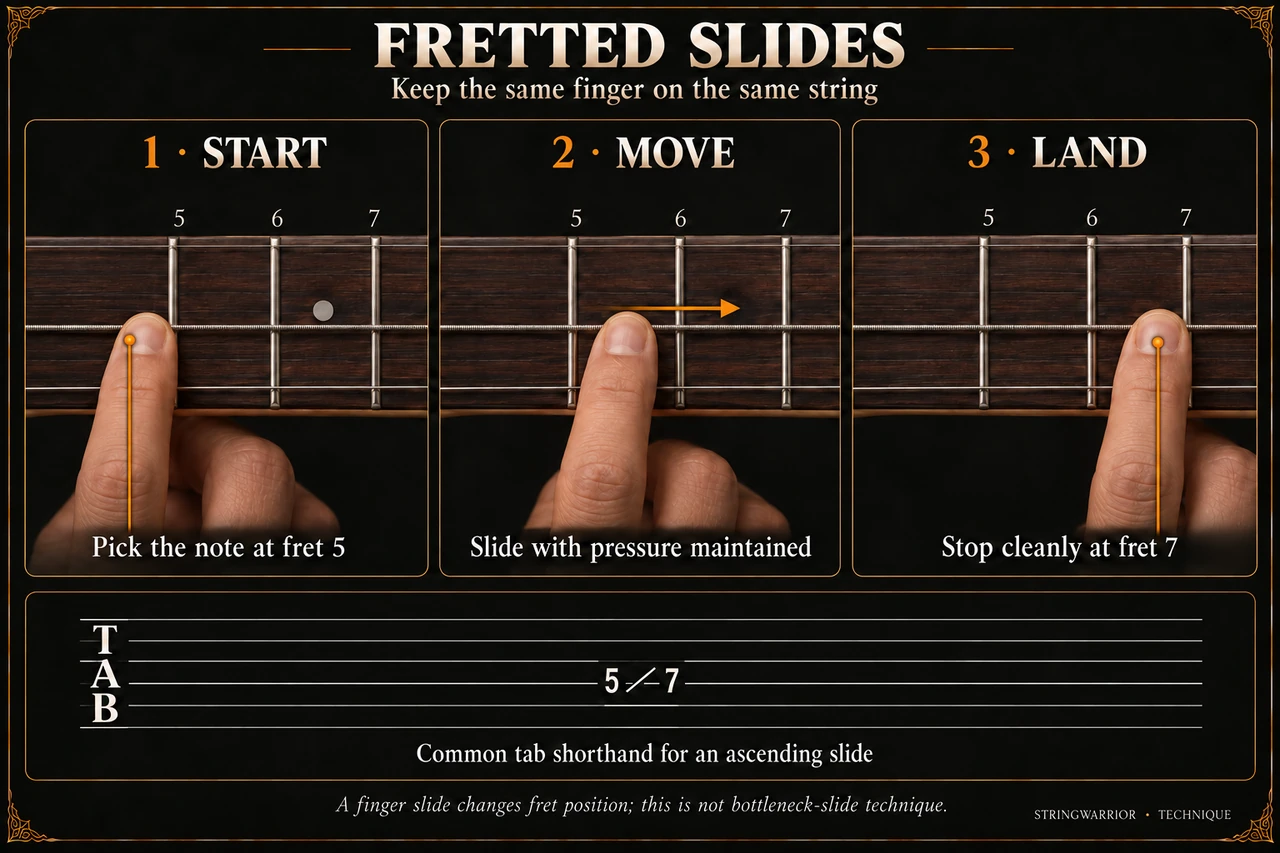
What slides is
A slide is the sound of a fretted note gliding along the string to a new fret. You pick once, keep the string pressed, and move your finger up or down the neck — the pitch travels continuously between the two notes instead of jumping. Musicians call this a glissando, and it is one of the most expressive, vocal-sounding moves on the instrument: it is the closest a guitar gets to a human voice bending from one word to the next.
There are two flavours. A legato slide is picked once — only the starting note is struck and the destination just arrives under your finger. A shift slide re-picks the note you land on, so you hear the glide and a fresh attack at the target. In tab a slide is written with a slash or the letters sl: a forward slash / slides up in pitch (5/7) and a backslash \ slides down (7\5).
When to use it
Slides do two things beautifully. First, they connect positions: a single slide can move your hand from one scale box to the next in the middle of a run, so you keep playing instead of leaping and re-picking. That makes them the smoothest way to travel around the neck. Second, they add expression: sliding into a target note from a fret or two below gives it a lazy, vocal lead-in that is everywhere in blues, rock, and country, and a long slide down the neck at the end of a phrase is a classic dramatic sign-off. Because a slide has no hard attack, it always sounds smooth and connected — the opposite of a picked line.
Examples in tab
A note on audio: our engine plays clean, plucked notes, so it cannot reproduce a slide — the glide itself is a physical motion of your hand across the frets, not something we can synthesize note by note. The tab below is a visual reference: read it and hear the slide on your own instrument.
These examples are original exercises in standard tab. Remember / slides up in pitch and \ slides down; keep the string pressed the whole way so the note never stops.
Example 1 — Up and down. On the G string, pick fret 5 and slide up to fret 7; then pick fret 7 and slide back down to fret 5. Feel the pitch travel smoothly in both directions without lifting off.
e|-----------------
B|-----------------
G|--5/7------7\5---
D|-----------------
A|-----------------
E|-----------------
Example 2 — Slide into a target. Start a fret or two below the note you actually want and slide up onto it. Here you pick fret 6 on the B string and glide up onto fret 8 — the little lead-in gives the target its vocal, expressive character.
e|-----------------
B|--6/8------------
G|-----------------
D|-----------------
A|-----------------
E|-----------------
Example 3 — Connect two positions. Play frets 5 and 8 on the high E string, then slide 8 up to 12 to shift your whole hand into the next box in one motion. This is how a slide keeps a run moving instead of jumping.
e|--5--8/12--12----
B|-----------------
G|-----------------
D|-----------------
A|-----------------
E|-----------------
Example 4 — Descending phrase. A short, bluesy line that walks down using slides on two strings. Keep even pressure so each note sings all the way to its landing fret.
e|-------------------
B|--8\6--------------
G|--------7\5--------
D|-------------------
A|-------------------
E|-------------------
How to play it
A good slide is all about steady pressure and a relaxed, gliding hand. Set it up like this.
1. Fret and pick once
Press the starting note firmly and pick it. For a legato slide that is the only pick stroke you make — the string must keep ringing on its own as you move, so it needs a good, solid start.
2. Keep the pressure and glide
Move your finger to the target fret without ever letting up. Ease off even slightly and the note dies mid-slide. Glide the whole hand along the neck as one unit rather than stretching the finger.
3. Loosen the thumb
Let your thumb trail loosely behind the neck so the hand can travel freely. A tight, clamping grip drags, scratches, and makes it hard to land accurately. The motion comes from the wrist and arm, not from squeezing.
4. Aim for the landing fret
Know exactly which fret you are heading for and stop right behind its wire. For a shift slide, pick the note again the instant you arrive; for a legato slide, just let the glide settle onto the target.
The fastest way to build accuracy is short, slow reps against a metronome: play Example 1 and make yourself land dead on the target fret every time before you speed up. Landing accuracy first, speed second.
Common mistakes to watch for:
- The note dies partway. You released pressure while sliding. Keep the fingertip pressed firmly against the string all the way to the target.
- Overshooting or undershooting. Landing on the wrong fret is the usual beginner slip. Slow down and aim; accuracy comes from knowing the destination before you move.
- A scratchy, gripping slide. Too much downward force or a clenched thumb makes the slide scrape and slow. Loosen the hand and let it glide.
- Re-picking a legato slide. If the tab shows one slide with no second pick, do not strike the target — its whole charm is arriving silently under your finger.
Related on String Warrior
Take slides to the fretboard:
- All guitar techniques
- Hammer-ons & pull-offs — the other main way to connect notes legato
- String bending — the other big expressive pitch move
- Vibrato — pairs perfectly with a slide landing on a target note
- Alternate picking — the picked runs your slides connect
- Guitar licks, guitar exercises, and the scale library whose boxes slides link together
- Guided practice routines, songs to play, and the Learn path for beginners
- How to read tab, including the slide symbols
Slides FAQ
- What is the difference between a slide and a bend?
- A slide moves your finger along the string to a different fret, so the pitch changes because you are at a new position. A bend pushes the string across the neck at the same fret, stretching it to raise the pitch. A slide travels up and down the length of the string; a bend stays put and stretches sideways.
- Do I pick the note I slide to?
- It depends on the slide. A legato slide is picked once — you strike the starting note and let the target arrive silently under your finger. A shift slide re-picks the destination, so you hear the glide and then a fresh attack. Tab tells you which: if there is no second pick marked, do not strike the target.
- How do I keep the note ringing through the whole slide?
- Keep firm, even pressure on the string from the first note all the way to the last, and move your whole hand along the neck as one unit rather than reaching with the finger. If the note fades out partway, you are letting up on the pressure mid-slide.
- What instruments do slides work on?
- Guitar, bass, ukulele, and mandolin — any fretted string instrument. The motion is the same on each; you only adjust for string spacing and how firmly you press. Electric guitar slides the most freely thanks to lighter strings and lower action.