What bends is
A bend is the sound of a fretted note being pushed sharp — you keep the string pressed and shove it sideways across the neck, stretching it tighter so the pitch rises. Instead of jumping to a new fret, the note glides upward under your finger until it reaches a higher pitch, and that continuous rise is what gives bending its crying, vocal quality. It is the closest a guitar comes to a singer sliding up into a note, and it is the beating heart of blues and rock lead guitar.
Bends are measured in how far they raise the pitch. A half-step bend raises the note by one fret; a full-step (or whole-step) bend raises it by two frets; and a small quarter-step curl nudges the note just enough to sound bluesy without landing on a new pitch. In tab a bend is written with a b: 7b9 means fret 7, bent up until it sounds like fret 9. An r marks the release back down, and on this page pb marks a pre-bend — a bend pushed up before you pick.
When to use it
Bending does two things nothing else can. First, expression: bending up into a target note, rather than just fretting it, gives it a lazy, vocal lead-in that is the signature sound of a blues or rock solo. Second, emphasis and tension: holding a note bent slightly sharp of pitch, or bending and releasing over a chord, creates a pull that begs to resolve. Bends live where the melody notes of a scale are — which is why they are inseparable from the minor pentatonic box most lead lines are built from. Pair a bend with vibrato at the top and you have the two moves behind almost every memorable guitar solo.
Examples in tab
A note on audio: our engine plays clean, plucked notes, so it cannot reproduce a bend — the bend itself is a physical motion, your finger stretching the string across the neck, not something we can synthesize note by note. The tab below is a visual reference: read it and hear the bend on your own guitar.
These examples are original exercises in standard tab. Read the symbols like this: b bends up to the pitch of the number after it (so 7b9 is fret 7 bent up to fret 9), r releases the bend back down, and pb is a pre-bend — reach the pitch before you pick.
Example 1 — Half-step vs. full-step. On the G string, bend fret 7 up one fret (a half step) to feel the smaller stretch, then bend it up two frets (a full step). Say each target out loud by fretting it normally first, then match it with the bend.
e|--------------------
B|--------------------
G|--7b8------7b9------
D|--------------------
A|--------------------
E|--------------------
Example 2 — Bend and release. Pick fret 7 on the G string once, bend it up a full step, then let it fall back down to pitch while it is still ringing. One pick, three moments: the start, the top, and the return.
e|--------------------
B|--------------------
G|--7b9r7------------
D|--------------------
A|--------------------
E|--------------------
Example 3 — Pre-bend and release. Bend the B string at fret 8 up a full step silently before you pick (that is the pb), strike it while it is already stretched sharp, then release down to fret 8. The note appears high and droops onto pitch — a haunting, backwards-sounding effect.
e|--------------------
B|--8pb10r8----------
G|--------------------
D|--------------------
A|--------------------
E|--------------------
Example 4 — Unison bend. Fret the high E string at fret 5 and hold it, then bend the B string at fret 8 up a full step so it climbs to the same pitch. The two strings meet on one note for a thick, wailing sound. Pick both together and bend only the lower string.
e|--5----------------
B|--8b10-------------
G|--------------------
D|--------------------
A|--------------------
E|--------------------
How to play it
A good bend is about leverage and pitch, not raw finger strength. Set it up like this.
1. Bend with support fingers
Almost never bend with one fingertip alone. If you bend at fret 9 with your third finger, lay your first and second fingers on the same string behind it and push as a team. Three fingers together bend easily and stay in control; one finger fights the string and drifts out of tune.
2. Rotate from the wrist
The power comes from turning your forearm and wrist, like slowly turning a doorknob, not from curling the fingertip. Keep the finger firm and let the whole hand rotate to push the string. This is stronger, smoother, and far less tiring.
3. Anchor the thumb
Hook your thumb over the top edge of the neck so your hand has something to pull against. That grip turns the bend into a squeezing motion between thumb and fingers and gives you the leverage to reach a full step in tune.
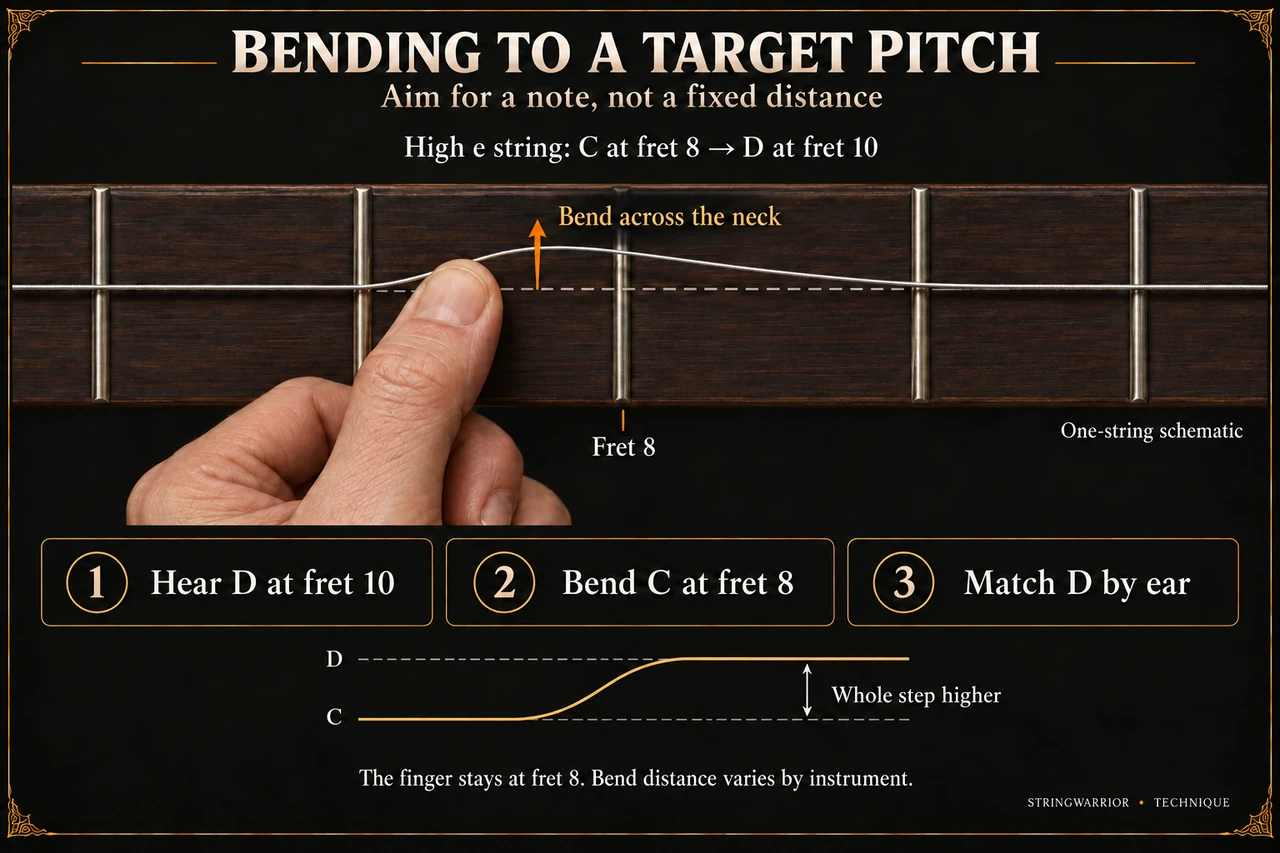
4. Aim at a pitch, not a distance
A bend is only right when it lands on the correct note. Fret the target note normally first so your ear knows the sound, then bend up until the two match exactly. Train your ear, not just your muscles — pitch is everything.
The fastest way to bend in tune is to check yourself: play the target note, then bend up to it and compare, using a tuner until the distance becomes automatic. Keep your other fingers resting lightly on the strings so nothing rings or squeals as you push. Direction matters too — on the lower strings you usually push up toward the ceiling, and on the top two strings you pull down toward the floor, so the string does not slide off the fretboard.
Build bends up in this order:
- Quarter-step curl — a tiny bluesy nudge that sits between two frets; no target pitch to hit, so it is the gentlest start.
- Half-step bend — one fret up; easy to check against the fretted note right above it.
- Full-step bend — two frets up; the workhorse of rock and blues and the hardest to keep in tune at first.
- Bend and release — control the whole arc up and back down without re-picking.
- Pre-bend and release — hear the pitch drop onto the note on cue.
- Unison and double-stop bends — thick two-note bends where one string bends to meet another.
Common mistakes to watch for:
- Bending short. Stopping below the target pitch is the number-one bend problem and it always sounds sour. Slow down and match the fretted note exactly before you speed up.
- Bending with one finger. A lone fingertip has no strength or control. Stack support fingers behind it and rotate from the wrist.
- The string slipping under your finger. Push with the fleshy pad and use enough grip that the string travels with you instead of sliding off.
- Noise from the other strings. A bend uncovers extra strings; let your remaining fingers and your picking-hand palm rest across them to keep everything quiet.
Related on String Warrior
Take bends to the fretboard:
- All guitar techniques
- Vibrato — the perfect partner; add it at the top of a bend to make the note sing
- Slides — the other big expressive pitch move, gliding along the string instead of stretching it
- Hammer-ons & pull-offs — the legato notes your bends punctuate
- Guitar scales — the minor pentatonic box where nearly every bend lives
- Guitar licks and guitar exercises to drill bends in real phrases
- Guided practice routines, songs to play, and the Learn path for beginners
- Tuner to train your bends in tune, and how to read tab, including the bend symbols
Bends FAQ
- How do I bend a string in tune?
- Fret the target note normally first so your ear knows the pitch, then bend up until the bent note matches it exactly. Push with two or three fingers together for control and check yourself against a tuner until the distance becomes automatic.
- What is the difference between a half-step and a full-step bend?
- A half-step bend raises the pitch by one fret, and a full-step or whole-step bend raises it by two frets. Full-step bends are the most common sound in rock and blues, while half-step bends give a tenser, more biting lift.
- Why is bending so hard or painful on my guitar?
- Usually the strings are heavy, the action is high, or you are pushing with a single fingertip. Support the bend with two or three fingers, rotate from your wrist instead of your finger, and consider lighter strings on an electric. It gets much easier as your hand builds strength.
- Can you bend strings on acoustic guitar or bass?
- Yes, though both are stiffer than an electric. Acoustic strings are heavier, so bends usually stay to a half or full step, and bass players lean on small, expressive half-step bends. Electric guitar with light strings bends the most freely.