What vibrato is
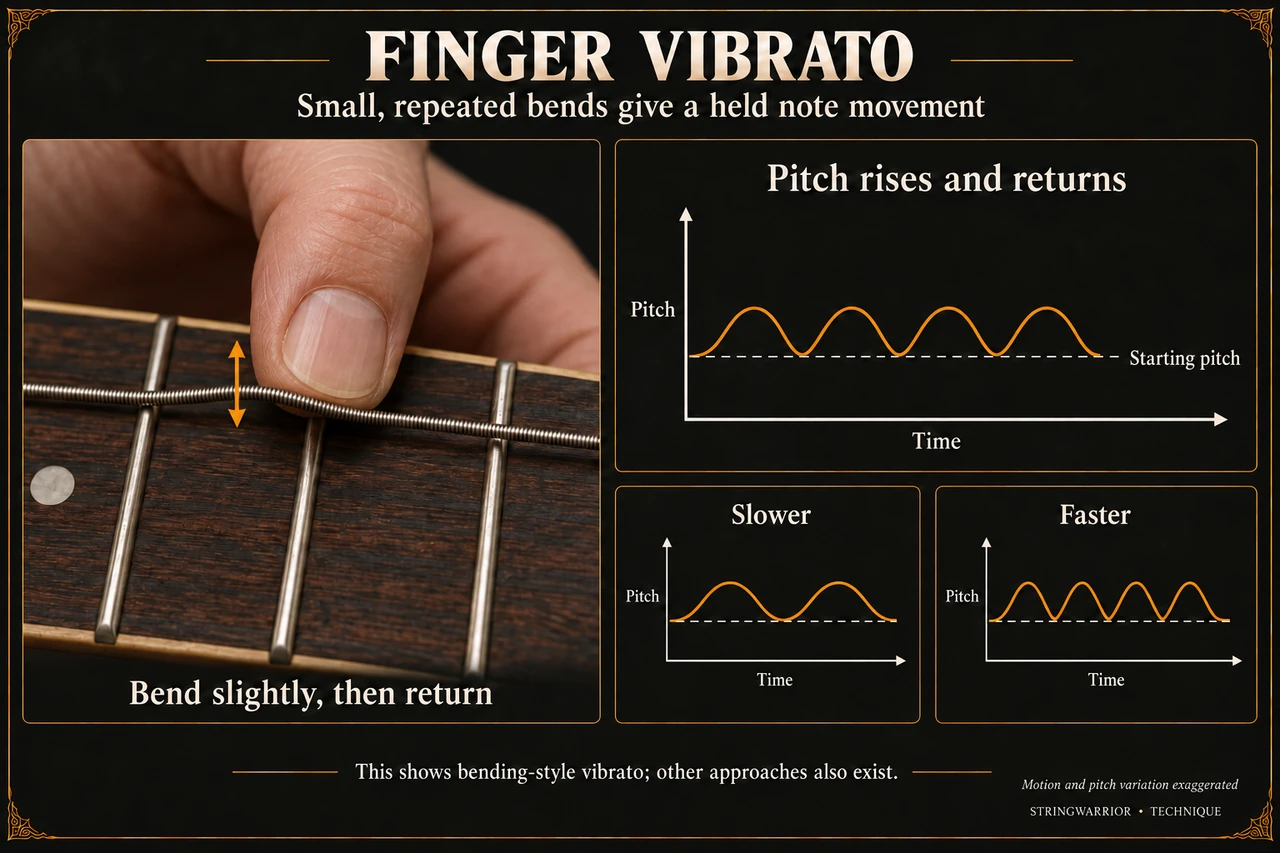
Vibrato is a held note whose pitch wavers up and down in a steady, repeating pulse. Instead of letting a note ring flat and lifeless, you make it breathe — the pitch rises a little and returns, over and over — and that gentle waver is what makes the note sing. It is exactly what a singer or a violinist does to sustain a note with warmth, and on guitar it is one of the clearest fingerprints of a player's voice: two people can hit the same note and sound completely different because of it.
There are two main flavours. Rock and blues vibrato is a bending vibrato — a series of tiny, fast bends and releases that push the pitch up from the note and let it fall back. Classical vibrato rolls the fingertip back and forth along the length of the string, wavering the pitch far more subtly, and suits nylon-string and acoustic playing. Two qualities describe any vibrato: its width (how far the pitch moves, narrow to wide) and its speed (how fast it pulses). In tab, vibrato is marked with a wavy line or tildes after a note — on this page, ~~~.
When to use it
Vibrato earns its keep on long, important notes — the note you land on at the end of a phrase, the peak of a solo, a sustained chord tone. A plain held note fades and dies; add vibrato and it stays alive and expressive for as long as you want it. It is also the natural finish to the other expressive moves: bend up to a target and shake it at the top, or slide into a note and settle it with vibrato. Because vibrato is so personal, matching it to the music matters — a fast, driving tune wants a quicker, tighter vibrato, while a ballad calls for something slow and wide.
Examples in tab
A note on audio: our engine plays clean, plucked notes, so it cannot reproduce vibrato — the waver is a physical motion of your hand shaking the string, not a change we can synthesize note by note. The tab below is a visual reference: read it and hear the vibrato on your own guitar.
These examples are original exercises in standard tab. The ~~~ after a note means hold that note and add vibrato for as long as the tildes run; more tildes just means let it sing longer.
Example 1 — Slow and wide. Fret the G string at fret 9, pick it once, and add a slow, wide, exaggerated vibrato. Make each waver even and rhythmic, almost like a pulse you could count. Start deliberately overdone — control comes before subtlety.
e|--------------------
B|--------------------
G|--9~~~~~~~----------
D|--------------------
A|--------------------
E|--------------------
Example 2 — Narrow and fast. The same idea higher up: pick fret 10 on the B string and shake it with a tighter, quicker vibrato. Keep it even — a fast vibrato is only good if every pulse is the same width.
e|--------------------
B|--10~~~~~~~---------
G|--------------------
D|--------------------
A|--------------------
E|--------------------
Example 3 — Vibrato on a bent note. Bend the G string at fret 7 up a full step to fret 9's pitch, get it in tune, then shake from the wrist to waver the note at the top of the bend. This is the most expressive combination on the guitar — and the hardest, because you must hold the bend in tune while you shake.
e|--------------------
B|--------------------
G|--7b9~~~~~----------
D|--------------------
A|--------------------
E|--------------------
Example 4 — Vibrato to finish a phrase. A short original line that rises through three notes and lands on the last one with vibrato. Play the first two cleanly, then pour everything into holding and shaking the final note.
e|-------------------
B|--------5~~~~~~----
G|--5--7------------
D|-------------------
A|-------------------
E|-------------------
How to play it
Good vibrato is even and controlled, not a nervous twitch. Build it from the wrist like this.
1. Think tiny bends
Rock and blues vibrato is really a string of small bends. Push the string up a little, let it come back to pitch, and repeat. Do it slowly at first and you will feel that it is the same motion as a bend, just smaller and repeated.
2. Move from the wrist
Anchor your thumb on the neck and rotate the wrist and forearm, like turning a key back and forth. The finger stays firm on the string and rides the motion. Wiggling only the fingertip is weak, uneven, and tiring.
3. Control width and speed
Decide how far the pitch moves and how fast it pulses, then keep both steady. Even, rhythmic vibrato sounds musical; a random shake sounds anxious. Practise wide-and-slow first, because a big motion is the easiest to keep in control.
4. Try classical vibrato too
For a subtler waver, especially on nylon-string or acoustic, roll the fingertip back and forth along the string toward and away from the bridge instead of bending across it. The pitch moves far less, giving a softer, more refined sound.
The key to musical vibrato is that it stays in tune: on guitar the string only sharpens when you push it, so start right on the true pitch and let the vibrato rise above it and return, rather than parking the note sharp. A metronome helps more than you would think — pulse your vibrato in time with the click (two or three wavers per beat) so it comes out even instead of frantic.
Build vibrato up in this order:
- Slow and wide — exaggerate it so you can feel and hear every pulse; this builds control first.
- Narrow and fast — tighten the motion while keeping every waver even.
- On sustained high notes — the thinner strings and higher frets take more control to keep steady.
- On bent notes — the hardest and most expressive: hold the bend in tune while you shake.
- Matched to the music — quick vibrato for fast tunes, slow and wide for ballads.
Common mistakes to watch for:
- A nervous, uneven shake. The classic beginner tell. Slow right down until every waver is identical, then rebuild the speed.
- Drifting sharp. If the note sits above pitch, you are not releasing all the way back. Vibrato should return to the true note on every cycle.
- Wiggling the fingertip. Vibrato from the fingertip alone is weak and thin. Drive it from the wrist and forearm with the finger firm.
- Too fast and thin. A quick, narrow buzz sounds anxious. A slower, wider vibrato almost always sounds more confident and vocal.
Related on String Warrior
Take vibrato to the fretboard:
- All guitar techniques
- String bending — the same wrist motion; vibrato is really a string of tiny bends
- Slides — slide into a target note and finish it with vibrato
- Hammer-ons & pull-offs — the legato runs your vibrato notes cap off
- Guitar scales — the pentatonic notes you land on and shake
- Guitar licks and guitar exercises to drill vibrato in real phrases
- Guided practice routines, songs to play, and the Learn path for beginners
- Metronome to keep your vibrato even, and how to read tab, including the vibrato marking
Vibrato FAQ
- What is the difference between vibrato and a bend?
- A bend pushes the pitch up to a new target and holds it there, while vibrato wavers the pitch up and down repeatedly around a single note. In fact, rock and blues vibrato is really a series of tiny, fast bends and releases.
- Should guitar vibrato go up from the note or below it?
- On guitar you almost always waver up from the note and return to it, because pushing or pulling the string only raises the pitch. Start right on the true note so it stays in tune, and let the vibrato add width above it.
- How do I make my vibrato smooth instead of shaky?
- Slow it down and keep it even. Move from your wrist and forearm rather than twitching the fingertip, and hold the width and speed steady and rhythmic. A slow, wide, controlled vibrato sounds far better than a fast, nervous one.
- Can I add vibrato to a bent note?
- Yes, and it is one of the most expressive moves on the guitar. Bend up to your target pitch first and get it in tune, then shake from the wrist at the top of the bend so the pitch wavers while the note sustains.