The honest answer
You will hear that beginners “have to start on acoustic” because it is harder and builds discipline. Ignore it. There is no rule, and plenty of great players began on an electric. The two instruments are different tools, not a beginner tier and an advanced tier, and the best first guitar is the one that plays the music you are excited about — because excitement is what carries a beginner through the first sore-fingered weeks.
That said, the two do feel different under the hands and cost different amounts to get playing, and those differences are worth understanding before you spend anything. This guide lays out the real trade-offs — comfort, cost, quiet practice, sound, and upkeep — so you can pick with your eyes open. As with all our guides, we talk in categories and price ranges rather than fixed prices, and we recommend by feature rather than by brand.
The case for starting on acoustic
An acoustic is the ultimate grab-and-go instrument. There is no amp, no cable, and no power — you pick it up and it makes sound, which quietly removes friction from daily practice. It is the natural home of folk, singer-songwriter, country, and campfire strumming, and because you hear the raw string, sloppy fretting has nowhere to hide, so it can teach clean technique.
The trade-offs are physical. Acoustic strings are heavier and under higher tension, and the body is larger, so pressing chords asks more of new fingertips and the reach can feel big — especially on a chunky dreadnought. There are fewer knobs to hide behind, and you cannot turn it down: it is as loud as you strum, which is not ideal for a late-night practice in a shared home.
The case for starting on electric
An electric is usually the easiest thing to fret. The strings are lighter, the action is typically lower, and the neck is often slimmer, so barre chords and stretches come with less hand strain — a real advantage in the first months. Plug into a small amp with a headphone jack and you can practice silently at any hour, and turn the volume down to a whisper when you need to. It is the instrument of rock, blues, metal, and funk, and the platform for lead playing, bends, and everything a solo is built from.
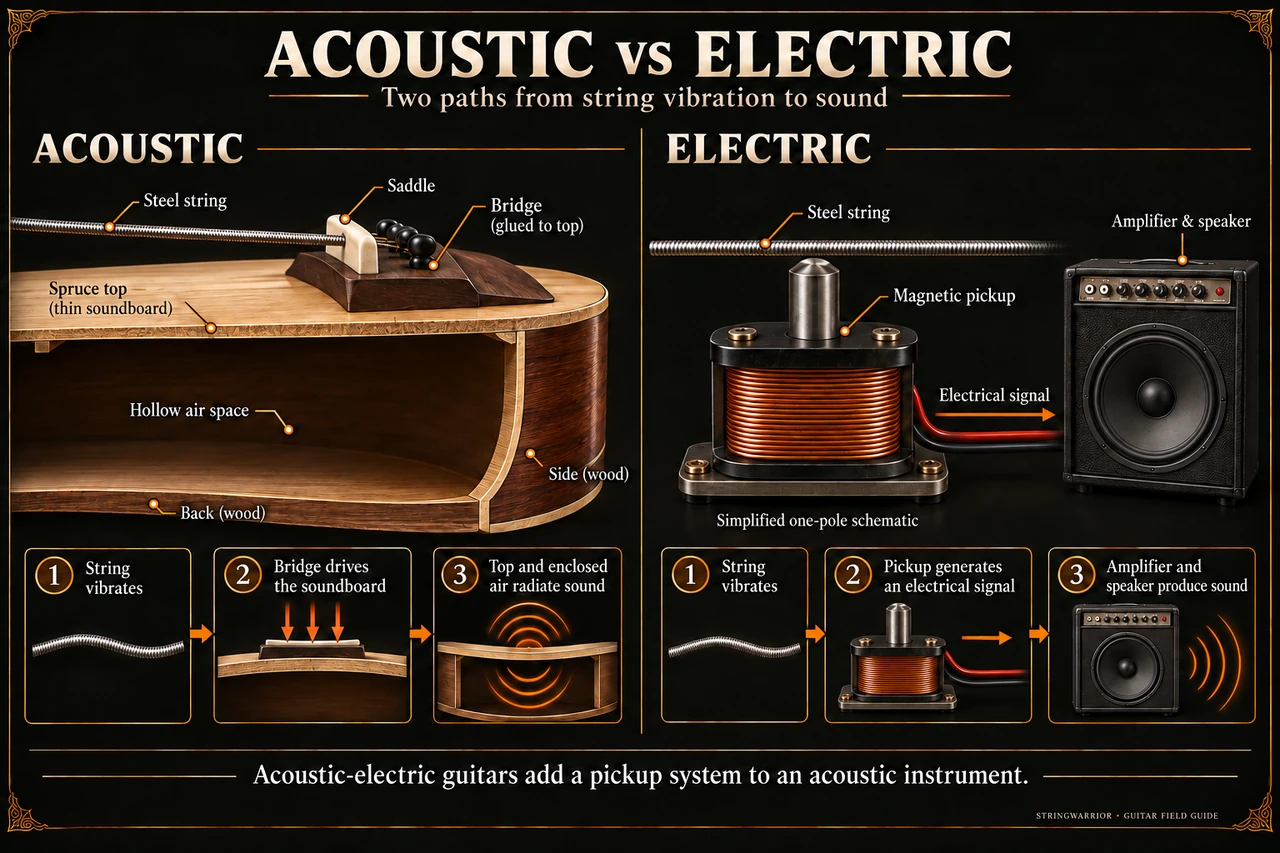
The trade-off is that an electric only reaches its full voice through an amp, so getting started means buying a guitar and a small amp and cable — a bit more money and one more thing to learn. There are also more controls to understand: pickup selector, volume, and tone. None of that is hard, but it is a slightly steeper first step than picking up an acoustic and strumming. If pickups are new to you, our pickup types reference is a gentle place to start.
Side by side
The same trade-offs, at a glance. None of these is a knockout blow on its own — weight the rows that matter to your situation.
| Factor | Acoustic | Electric |
|---|---|---|
| Cost to start playing | Just the guitar | Guitar plus a small amp and cable |
| Ease of fretting | Heavier strings, higher tension | Lighter strings, lower action — usually easier |
| Neck feel | Often wider, especially on a dreadnought | Typically slimmer and shorter reach |
| Quiet practice | As loud as you strum | Silent through headphones; volume on a dial |
| Grab-and-go | Immediate and self-contained | Needs plugging in for its full sound |
| Best-fit styles | Folk, singer-songwriter, country, pop | Rock, blues, metal, funk, and lead playing |
| Upkeep | Strings and the occasional setup | Strings and setup, plus amp, cable, and electronics |
A third option: classical (nylon-string)
It is easy to forget the classical guitar, but it is the gentlest first instrument of all. The nylon strings are soft and low-tension, so they are the kindest to tender fingertips, and the neck is wide and flat. That width suits fingerstyle and classical repertoire beautifully, though it can make tight chord grips feel like a stretch, and it does not deliver the steel-string jangle of pop or the crunch of rock. It is a strong choice for young children, for classical and fingerstyle players, and for anyone whose main worry is sore fingers. Steel-string strummers usually want an acoustic or electric instead.
The sore-fingers question
Every new player’s fingertips hurt for the first couple of weeks, on any guitar, until calluses form — that is universal and it passes. Acoustic strings are heavier, so they can sting a little more at first, but the difference is smaller than beginners fear, and it is dwarfed by two things you control: string gauge and setup. Light strings and a low, well-adjusted action make far more difference to comfort than the acoustic-versus-electric choice does. In other words, do not pick electric just to spare your fingers — pick the instrument you want, then make it comfortable with lighter strings and a good setup.
Cost, honestly
The fairest way to compare price is “all-in” — everything you need to actually make music, not just the sticker on the guitar. Treat the figures as region-dependent categories rather than quotes.
- Acoustic, all-in: the guitar, a clip-on tuner, picks, and a gig bag. Because there is no amplification, the acoustic is usually the cheaper path to a first sound.
- Electric, all-in: the guitar, a small practice amp, a cable, a tuner, and picks. The amp adds a modest amount, so an electric setup generally costs a little more to get playing than a comparable acoustic.
- Starter packs: bundled electric kits fold the amp, cable, and strap into one price and can be good value — just confirm the guitar itself comes from a genuine starter line rather than a throwaway built only to hit a price.
Whichever you choose, leave a little room in the budget for a professional setup. It is the cheapest, biggest upgrade to how the guitar plays, and it applies equally to both.
How to decide
When the trade-offs feel balanced, let the music break the tie. Picture the songs you daydream about playing a year from now:
- Singer-songwriter, folk, country, worship, or campfire sing-alongs? Lean acoustic — it is built for strumming and voice, and it is ready the moment you pick it up. See country.
- Rock, blues, metal, or funk, or anything with solos? Lean electric — lighter strings, quiet practice, and the platform for lead work. See blues, metal, and funk.
- Classical, fingerstyle, or a very young child? Consider a nylon-string classical for the softest, most forgiving start.
- Genuinely torn? Pick the one you find more beautiful to look at. You will practice the guitar you want to hold, and either one will teach you the fundamentals.
Once you know which way you are leaning, our focused picks make the next step concrete: best beginner acoustic guitars and best beginner electric guitars. Still zoomed out? How to choose your first guitar walks the whole decision from the top.
How we make these recommendations
This is an editorial, non-affiliate comparison. There are no affiliate links on the page and no sponsored placements — just the durable trade-offs between two kinds of instrument. We describe features and categories rather than pushing a brand or quoting a price, and the “Last updated” date at the top moves whenever the advice changes, so the guidance keeps pace even as specific models come and go.
Related on String Warrior
Take the decision further:
- All buying guides — the full set of neutral beginner guides.
- How to choose your first guitar — the full beginner walkthrough.
- Best beginner acoustic guitars · best beginner electric guitars.
- Guitar anatomy & gear, including pickups and the neck.
- Guitar landing · all instruments · beginner path.
- Strumming, fingerpicking, and guitar chords to start playing on either one.
- Tuner · browse guitar styles to find the sound you want.