Start with playability, not the price tag
The best first guitar is simply the one you will pick up and play. A comfortable, well-adjusted instrument removes excuses; a stiff, buzzing one becomes a coat rack. Three things decide whether a beginner sticks with it: how easy it is to press the strings down, whether it stays in tune long enough to finish a song, and whether you like the look and sound enough to reach for it every day. Everything below serves those three goals.
Two habits keep this guide trustworthy and keep you out of trouble. First, we recommend by type and spec — body size, string type, action, build quality — rather than by brand, because the specs stay true across model years while the logos come and go. Second, we speak in price ranges and categories, never fixed prices, because exact numbers move with country, currency, and the year. The most important thing you can learn here is that a modest guitar that has been set up to play easily beats an expensive one that has not.
Acoustic, electric, or classical?
This is the first real fork, and there is no universally correct answer — the myth that you “have to start on acoustic” is just that, a myth. Pick the one that matches the music you actually want to play, because motivation is the thing that gets a beginner past the first sore-fingered month.
Steel-string acoustic
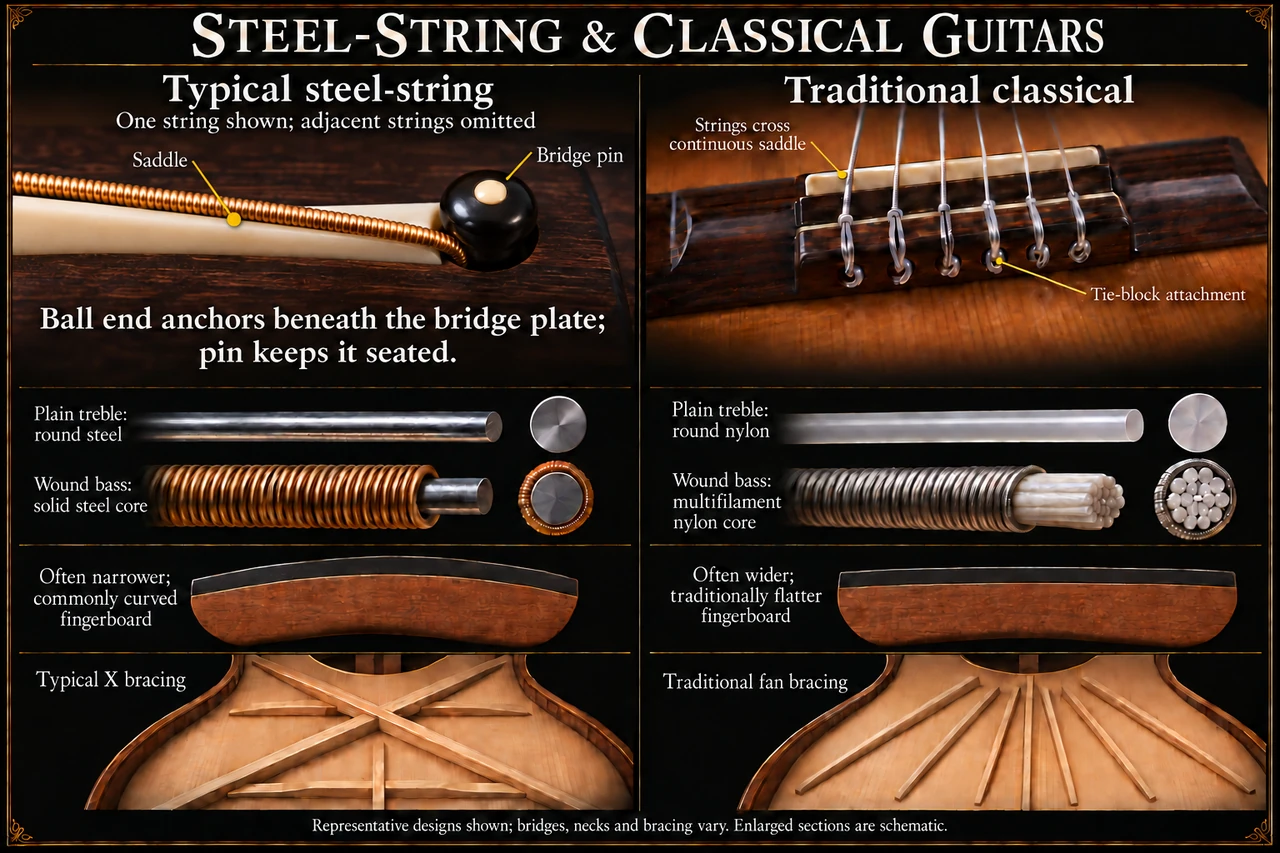
Self-contained and portable — no amp, no cable, ready the moment you pick it up. Great for singer-songwriter, folk, country, and campfire strumming. The trade-off is heavier strings and a bigger body, so it asks a little more of new fingertips.
Electric
Usually the easiest to fret: thinner neck, lighter strings, and lower action. You can practice silently through headphones. The catch is that it needs a small amp to be heard, which is one more thing to buy and learn. Ideal if you are drawn to rock, blues, metal, or funk.
Classical (nylon-string)
Soft nylon strings and a wide, flat neck make it the gentlest on the fingers — a common choice for young children, classical and fingerstyle players, and anyone with very tender fingertips. The wide neck suits fingerpicking more than tight chord grips.
Not sure which way to lean? Our companion guide on acoustic vs. electric for beginners weighs cost, comfort, and quiet practice in detail. When you have chosen a lane, dig into the specifics with best beginner acoustic guitars or best beginner electric guitars. Set on a different instrument entirely? See our guides to beginner bass guitars and beginner ukuleles.
Fit the guitar to the player
A guitar that is too big or has too long a reach is the quiet reason many beginners give up — the problem feels like “I can't do this” when it is really “this instrument doesn't fit me.” Match the body size and scale length (the working length of the strings) to the person who will actually hold it.
| Player | Good starting point | Why |
|---|---|---|
| Most adults and teens | Full-size acoustic (dreadnought or concert), or a standard-scale electric | Standard proportions suit average hands and reach. |
| Smaller adults, or anyone finding a dreadnought bulky | Concert / grand-concert or parlor acoustic; a lighter, smaller-bodied electric | A smaller body sits closer to you and shortens the reach around the shoulder. |
| Children roughly 5–8 | 1/2 or 3/4 size, often nylon-string | Short scale and low string tension are kind to small fingertips. |
| Children roughly 8–12 and petite teens | 3/4 size, or a short-scale electric | Easier stretch without feeling like a toy. |
| Very tender fingertips, or classical/fingerstyle interest | Nylon-string classical | Soft strings and a wide, flat neck are the most forgiving to press. |
Scale length and neck shape live in the details — our guitar neck reference explains profiles and scale, and the body types page covers how shape changes comfort and sound.
Set a realistic budget
Exact prices shift with country, currency, and the year, so read the tiers below as broad categories, not quotes. The single most useful budgeting idea for a beginner: spend a little less on the instrument and save room for a professional setup, because the setup is what makes any guitar easy to play.
| Tier | What it usually means | Our take |
|---|---|---|
| Ultra-budget / toy | The cheapest bracket — discount-store or unbranded instruments, sometimes sold as toys. | Often will not hold tune or set up well. Avoid unless you knowingly need a short-term stopgap. |
| Starter | The established beginner bracket from reputable starter lines of major makers. | The sweet spot for most first guitars — fully playable once it has been set up. |
| Step-up | Better woods and hardware, tidier fit and finish; solid-top acoustics live here. | Worth it if the budget stretches, or if you are already fairly sure you will stick with it. |
As a rough, region-dependent guide, a good starter guitar body tends to sit in the low-to-mid hundreds in most markets. An electric also needs a small practice amp, which adds a modest amount on top — factor the amp into the budget from the start so you are not surprised. Many makers sell electric “starter packs” that bundle a guitar, amp, cable, and strap; they are convenient, but check that the guitar itself is from a real starter line rather than a throwaway built to hit a price.
What “plays well” actually means
“Playability” is not a vibe — it is a handful of measurable things. Whether you shop in a store or online, these are what to check or have a tech check for you. A guitar can nail most of them and still need a setup, which is normal and cheap.
Action (string height)
How far the strings sit above the frets. High action fights you on every chord and is the number-one reason a cheap guitar feels “hard.” It is also the easiest thing to fix in a setup.
Neck straightness
A tiny forward bow is normal; a warped or twisted neck is a dealbreaker. Sight down the neck from the headstock like looking down a pool cue — it should look almost straight, with no waves.
Intonation
Does it stay in tune as you move up the neck? Compare the harmonic at the 12th fret to the note fretted there — they should match. Bad intonation makes everything sound subtly sour.
Fret ends and buzz
Run a finger along the edge of the neck; sharp fret ends catch the skin and mean extra work. Play every fret on every string and listen for buzz or dead notes.
Tuning stability
Tune up, play for a few minutes, and see if it drifts. Slippage usually points to cheap tuners or a poorly cut nut rather than anything you did wrong.
The setup itself
A shop setup — adjusting action, neck relief, and nut — transforms an inexpensive guitar and is the highest-value money in this whole guide. Budget for one, especially on anything bought online.
Want to understand the parts behind those checks? The nut, the bridge, and the headstock and tuners each have their own plain-English reference in our guitar anatomy section.
New or used?
A used guitar can be the best value a beginner will ever find, because a step-up instrument bought second-hand often costs the same as a new starter one. The catch is that you take on whatever condition it is in. Buy used if you can bring along someone who plays, or if you are willing to run the playability checks above and budget for a setup. Watch for a straight neck, working truss rod, and no cracks; cosmetic dings do not matter. Buy new if you want a warranty, a known baseline, and the reassurance that nothing is quietly wrong — a fair trade for a beginner who is not yet sure what to look for.
The extras you actually need
A guitar is not the whole cost of getting started, but the genuinely necessary extras are cheap. Do not let a store talk you into a pile of accessories on day one.
Buy now:
- A tuner — a clip-on tuner or our free online tuner. Playing in tune from day one trains your ear and keeps practice from sounding wrong.
- A few picks (start with medium gauge), a spare set of strings, and a strap even if you play sitting down.
- A soft case or gig bag so the guitar survives being carried around.
- For an electric: a short cable and a small practice amp — one with a headphone jack is perfect for quiet practice.
- A capo is inexpensive and instantly unlocks a lot of songs.
Skip for now: effects pedals, boutique strings, fancy straps, and a second guitar. They are fun later, but none of them helps you learn faster today. One thing worth adding early is a metronome — steady timing is the habit that separates players who groove from players who rush.
Common beginner mistakes
- Buying the cheapest thing you can find. Toy-tier guitars are so hard to play that they cause beginners to quit and blame themselves. This is the mistake that matters most.
- Choosing on looks alone. A cool finish will not fix a bad neck. Judge the guitar by how it plays, not how it photographs.
- Skipping the setup. It is the biggest playability upgrade available and one of the cheapest — do not leave it on the table.
- Ordering online with no plan. Buying sight-unseen is fine if you budget for a setup when it arrives; a fresh guitar out of a box is rarely dialed in.
- Over-buying. A boutique guitar will not teach you faster. Put the difference toward lessons, a setup, or simply time playing.
- Ignoring body size. A big dreadnought can overwhelm a small player and make good technique feel impossible.
How we make these recommendations
Our buying guides are editorial and non-affiliate: there are no affiliate links on this page, and no product placement. We describe categories, features, and trade-offs — the things that stay true across brands and model years — rather than steering you to a specific model or quoting an invented price. The “Last updated” date at the top of the page changes whenever the advice does, so you can see how current it is. Recommending by type and spec is deliberate: it keeps this guidance useful long after any particular guitar has been discontinued.
Related on String Warrior
Keep going once you have chosen a guitar:
- All buying guides — the full set of neutral beginner guides.
- Acoustic vs. electric for beginners — settle the big fork.
- Best beginner acoustic guitars · best beginner electric guitars.
- Guitar anatomy & gear — how the instrument is built and what each part does.
- Guitar landing · browse all instruments.
- Beginner guitar path, plus guitar chords and guitar scales to start playing.
- Strumming and fingerpicking — the first two things you will do with any first guitar.
- Tuner and metronome · explore guitar styles to find your sound.