What harmonics are
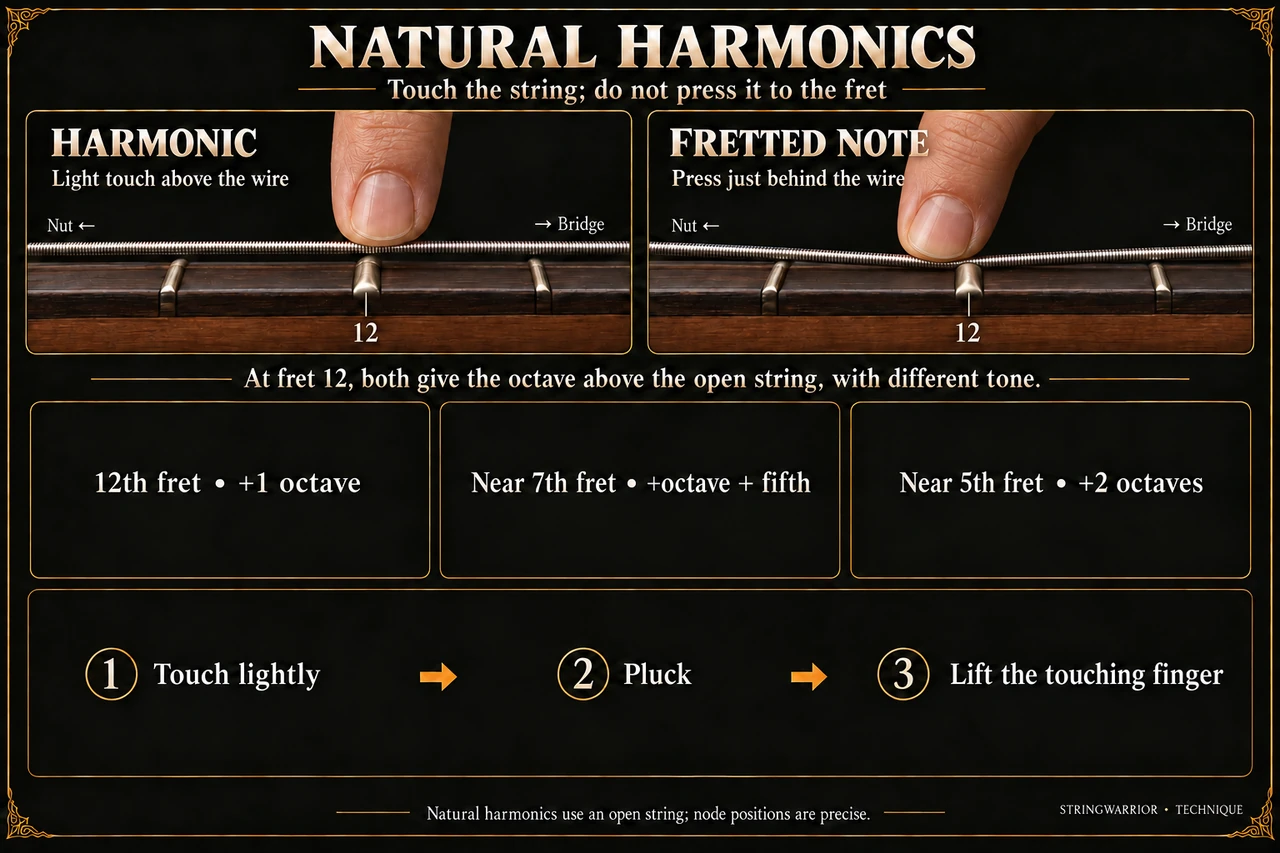
Every plucked string vibrates in more than one way at once: as a whole, but also in halves, thirds, quarters, and so on — the overtone series stacked inside a single note. A harmonic isolates one of those overtones. Instead of pressing the string down to a fret, you rest a finger on it lightly, right over a point that divides the string into equal parts, pick, and lift off. The full vibration is silenced and only that one pure overtone survives, ringing out as a clear, glassy, bell-like chime.
Natural harmonics live at the frets where an open string divides evenly. The strongest is directly over the 12th fret, the halfway point, which rings one octave above the open string. The 7th fret (and 19th) gives an octave plus a fifth; the 5th fret gives two octaves. In tab a natural harmonic is written with the fret in angle brackets — <12> — or marked "N.H." Beyond those, artificial harmonics (A.H.) and pinch harmonics (P.H.) let you force a harmonic out of any fretted note, so you are not limited to the open-string nodes.
When to use it
Harmonics are all about color. Natural harmonics add a shimmering, chiming sparkle that is perfect for gentle arpeggiated intros, ambient textures, and letting a chord ring out at the end of a phrase. The 5th- and 7th-fret harmonics double as a classic tuning reference, since they sound the same pitch on adjacent strings. Pinch harmonics are the squealing accents of rock and metal leads — a bright, screaming overtone snapped out of an ordinary note with the edge of the thumb. And artificial harmonics let fingerstyle and jazz players carry whole melodies and chords up into the glassy harmonic register, an octave above where they are fretted.
Examples in tab
A note on audio: our engine plays clean, plucked notes, so it cannot reproduce a harmonic — the chime comes from lightly touching the string at a node, a physical motion, not a pitch we can synthesize. The tab below is a visual reference: read it and produce the chime on your own guitar.
These are original exercises in standard tab. A number in angle brackets is a natural harmonic touched over that fret — <12> means "chime the harmonic above the 12th fret." A fret number followed by * marks a pinch harmonic (P.H.).
Example 1 — The octave chime. Rest a fretting finger lightly directly above the 12th fret wire — barely touching, not pressing — pick the string, and lift the finger off. Each string rings an octave higher, pure and bell-like. Work across all six until every one chimes cleanly.
e|--<12>--
B|--<12>--
G|--<12>--
D|--<12>--
A|--<12>--
E|--<12>--
Example 2 — The harmonic map. On the low E string, chime the harmonics over the 12th, 7th, and 5th frets in turn. Same light touch, three different nodes, and you hear the overtones climb: an octave, then an octave plus a fifth, then two octaves.
e|------------------
B|------------------
G|------------------
D|------------------
A|------------------
E|--<12>--<7>--<5>--
Example 3 — A shimmering chord chime. Chime the 12th-fret harmonics on the G, B, and high E strings in a quick cascade and let them ring together. The open strings there are G, B, and E, so the three harmonics stack into a glassy E minor chord an octave up.
e|--------<12>--
B|----<12>------
G|--<12>--------
D|-------------
A|-------------
E|-------------
Example 4 — Pinch-harmonic squeal. Fret and pick these G-string notes normally, but choke up on the pick so the edge of your thumb brushes the string a hair after the pick strikes — the note snaps up into a high squeal. Add a little gain and rotate the picking hand to find the sweet spot.
e|------------
B|------------
G|--7*----5*--
D|------------
A|------------
E|------------
How to play it
A clean harmonic is about a light touch in the right spot, not force. Set it up like this.
Touch, don't press
For a natural harmonic, rest a fretting finger on the string so lightly it barely dents it, directly over the fret wire — not behind it like a normal note. Press even a little and you get an ordinary fretted note instead of the chime.
Lift as you pick
Pick the string and take the touching finger off almost immediately. Leaving it resting on the string damps the overtone. Picking a little closer to the bridge, and picking firmly, makes the chime ring louder and longer.
Find the node
The chime only appears where the string divides evenly. The strongest nodes are over the 12th, 7th, and 5th frets, with fainter ones over the 4th and 9th. If nothing rings, slide your finger a hair either way until you land right on the node.
Pinch harmonics: hide the thumb
Fret and pick a note as usual, but grip the pick short so the edge of your thumb catches the string right after the pick does. Rotating the picking hand slightly and adding gain makes the squeal jump out. Where you pick along the string changes which harmonic sounds.
Build harmonics up in this order — get each ringing cleanly before moving on:
- 12th-fret octave. The easiest of all; get a clean chime on every string, as in Example 1.
- 7th and 5th frets. Example 2 — hear the overtones climb and learn where the nodes sit.
- Musical chimes. Example 3 — ring several harmonics together as a chord or a gentle melody.
- Pinch and artificial. Example 4 and beyond; add some gain and hunt along the string for where each note squeals.
Common mistakes to watch for:
- A dead, muted sound. You are pressing too hard (that just frets the note) or leaving the finger on the string. Touch lighter and lift off the instant you pick.
- Chimes only over some frets. You are off the node. The clearest natural harmonics sit directly over the 12th, 7th, and 5th fret wires — nudge your finger onto the exact spot.
- A weak or missing pinch harmonic. Too little thumb, the wrong spot, or no gain. Slide your picking hand along the string to find where that note squeals and add some distortion.
- A buzzy, choked attack. Pick decisively and a little closer to the bridge; a timid pick will not excite the overtone.
Related on String Warrior
Take harmonics to the fretboard:
- All guitar techniques
- Palm muting — the picking-hand position pinch harmonics grow straight out of
- String & fretting-hand muting — keep the other strings quiet so a single chime rings clean
- Tapping — the other advanced picking-hand technique to explore next
- Tuner — the 5th- and 7th-fret harmonics are a classic way to tune the guitar
- Guitar scales, guitar licks, and guitar exercises to use them in real playing
- Guided practice routines, songs to play, and the Learn path for beginners
- How to read tab, including harmonic notation
Harmonics FAQ
- What is a natural harmonic and where are they on the guitar?
- A natural harmonic is a pure overtone you sound by touching an open string lightly over certain frets instead of pressing it down. The clearest ones are directly above the 12th fret, which rings one octave up, the 7th fret, which gives an octave plus a fifth, and the 5th fret, which gives two octaves — the points where the string divides into equal halves, thirds, and quarters.
- Why won't my harmonics ring out?
- Almost always your touch is wrong. Rest your finger very lightly, directly over the fret wire rather than behind it, and lift it off the instant you pick — pressing down or leaving the finger on the string kills the chime. Picking a little harder and closer to the bridge also helps the overtone jump out.
- What is the difference between natural, artificial, and pinch harmonics?
- Natural harmonics use the open string over set frets. Artificial or tapped harmonics let you fret a note and force a harmonic twelve frets higher with your picking hand, so you can play them anywhere on the neck. Pinch harmonics squeal a harmonic out of a normal picked note by catching the string with the edge of your thumb as you pick.
- Can you play harmonics on acoustic guitar or bass?
- Yes. Natural harmonics ring beautifully on acoustic and are a staple of fingerstyle playing, and on bass they come out clear and are often used for chords and for tuning. Pinch harmonics are easiest on an electric with some gain, but the natural chimes work on any string instrument.