The parts of a ukulele
Every acoustic ukulele shares the same core parts as a small classical guitar: a hollow figure-eight body, a fretted neck, a slotted or solid headstock with geared or friction tuners, a saddle-and-bridge that anchors the strings to the top, and four nylon-family strings. The differences live in the details — size, bracing, bridge style, and the strings themselves.
- Body: a small, lightly-braced soundbox, usually figure-eight or pineapple-shaped, that resonates the strings’ energy.
- Top (soundboard): the front of the body, the single biggest contributor to tone — solid spruce, cedar, koa, or mahogany on better instruments; laminate on entry-level ones.
- Neck & fretboard: a short-scale neck (13″–20″ depending on size) topped with a rosewood, ebony, or walnut fretboard. Most ukes have 12–20 frets, with 12–14 clear of the body.
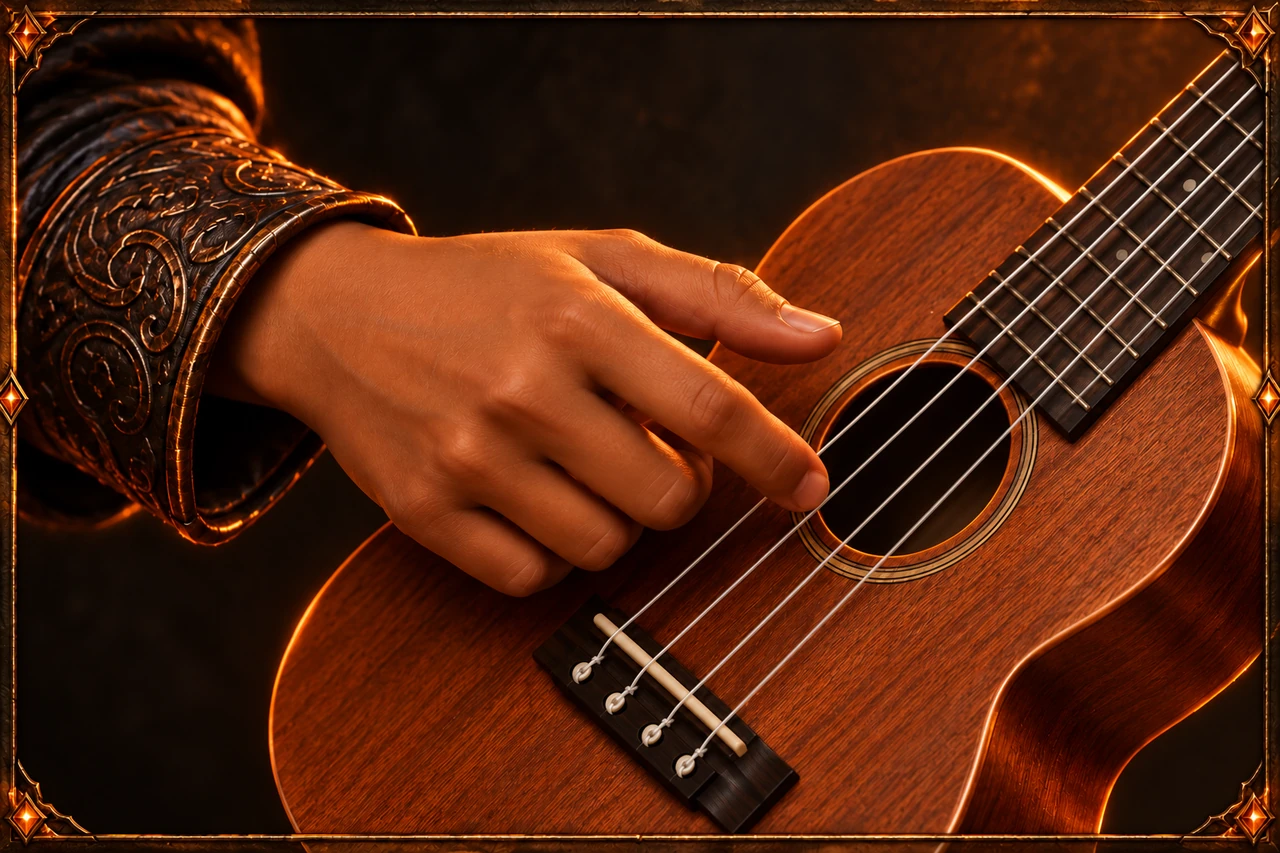
- Bridge & saddle: a glued-on hardwood bridge with a bone, Tusq, or compensated saddle. String anchoring varies — tie-bar, slot/slide, or pin styles all exist.
- Nut: a small bone or synthetic piece that sets string spacing and action at the headstock end.
- Tuners: friction pegs (traditional, light) or geared tuners (modern, more stable). Open-gear and sealed planetary types are both common.
- Strings: four courses of nylon, fluorocarbon, or Nylgut — sometimes with a wound low-G or wound C.
Sizes
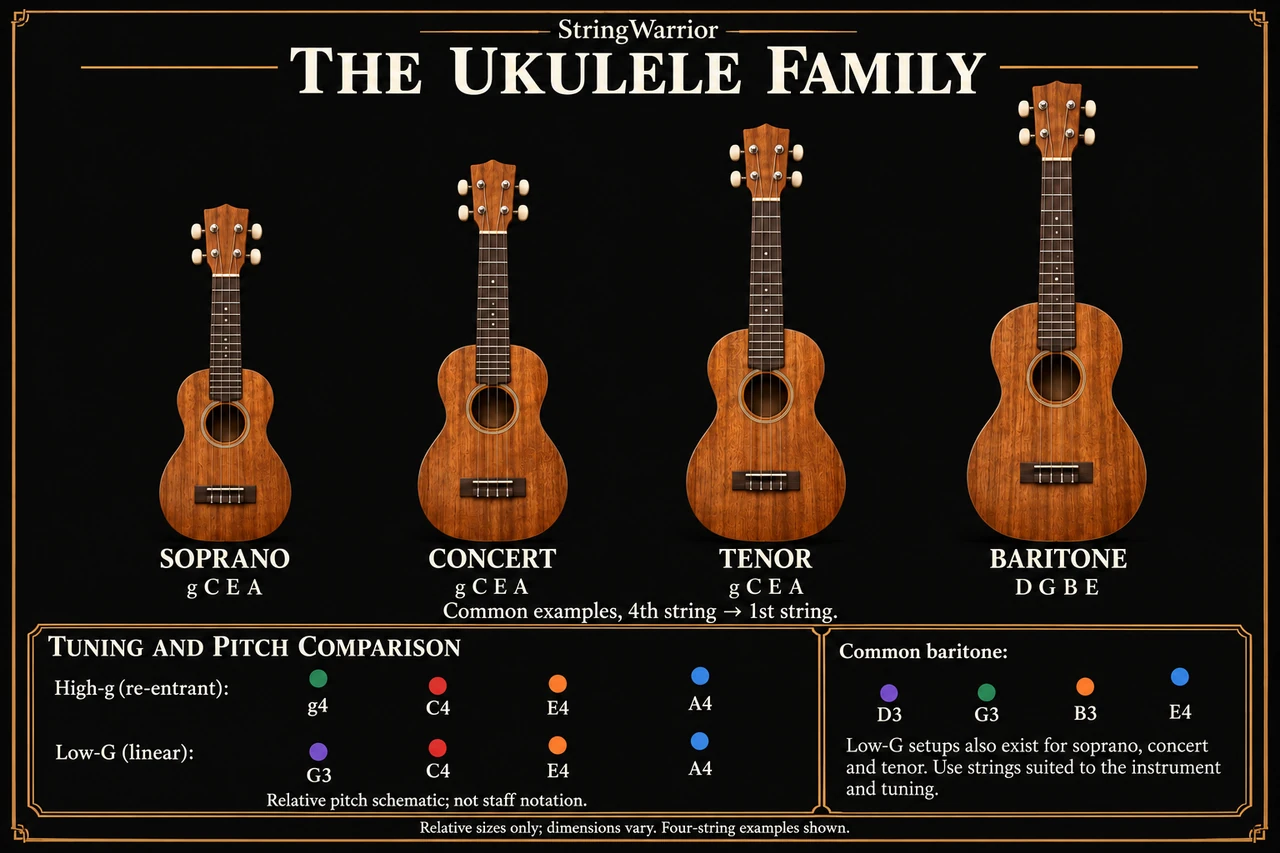
The ukulele family is defined by size more than anything else. Each size has a different scale length, tuning convention, and voice. Pick first by feel and fret spacing, then by the tone you want.
| Size | Scale | Standard tuning | Character |
|---|---|---|---|
| Soprano | ~13″ (33 cm) | G C E A | The classic, smallest, brightest voice — the “Hawaiian” uke sound. Tight fret spacing, lightest string tension, plinky and percussive. |
| Concert | ~15″ (38 cm) | G C E A | A step up in size and warmth. More room between frets, slightly louder and fuller than a soprano without losing the uke flavour. |
| Tenor | ~17″ (43 cm) | G C E A | The pro’s favourite. Richer low end, more sustain, comfortable for larger hands. Often strung with a wound low-G for guitar-like range. |
| Baritone | ~19–20″ (48–51 cm) | D G B E | Tuned like the top four strings of a guitar — great crossover instrument. Warmer, deeper, more intimate; sounds closer to a small classical guitar than a soprano uke. |
| Bass (U-Bass) | ~20–21″ (51–53 cm) | E A D G | A short-scale acoustic-electric bass with thick polyurethane (“Pahoehoe”) or thunder-gut strings. Surprisingly upright-bass-like under amplification. |
G C E A is usually played re-entrant — the G string is tuned an octave high, above the C and E. A linear (low-G) tuning swaps in a thicker, often wound G string for a fuller bass register and a more guitar-like layout.
Body shapes
Beyond size, ukuleles come in a handful of body silhouettes that affect projection, comfort, and (slightly) tone.
- Figure-eight (standard): the classical waisted body. Balanced tone, comfortable on the lap, the default shape on most ukes.
- Pineapple: a rounded, oval body with no waist. Slightly louder and warmer in the midrange; a Kamaka design from the 1920s that became iconic.
- Cutaway: a figure-eight with a scooped lower bout for upper-fret access. Common on tenors and baritones, useful for melodic playing above the 12th fret.
- Resonator: a metal or wood body with one or three aluminium cones — loud, bright, and biting. A National-style cousin of the resonator guitar.
- Solidbody electric: small slab-bodied ukes with magnetic or piezo pickups for plugged-in playing. Quieter unplugged; flexible amplified.
- Travel / flat-pack: ultra-thin or composite-bodied ukes for portability. Convenient, but tonally compromised compared to a full-body acoustic.
Tonewoods
Wood choice matters most on the top, then on the back and sides. Solid wood resonates more freely than laminate; the difference becomes obvious as an instrument is played in over months.
| Wood | Where used | Tonal character |
|---|---|---|
| Koa | Top, back & sides | The traditional Hawaiian wood. Bright when new, opens up beautifully with playing — sweet midrange, glassy top end, the “classic” uke voice. |
| Mahogany | Top, back & sides | Warm, woody, focussed midrange. Less shimmer than koa but more punch; the Martin uke staple. |
| Spruce | Top only | Loud, articulate, dynamic — opens up fast and projects strongly. A common choice on tenors paired with rosewood or mahogany backs. |
| Cedar | Top only | Warm, responsive, dark. Sounds “played in” from day one, but a touch less headroom than spruce at high volume. |
| Acacia | Top, back & sides | Koa’s cousin (same genus). Visually and sonically similar — bright, sweet, with rich figuring — usually at a friendlier price point. |
| Rosewood | Back & sides | Reflective, complex overtones, deep bass. Pairs well with a softwood top for a fuller-range voice. |
| Mango | Top, back & sides | Between koa and mahogany — warm, full, with attractive figure. Increasingly popular on Hawaiian-built ukes. |
| Laminate | Top, back & sides | Thin plies glued together — tougher, cheaper, and humidity-stable. Less open and resonant than solid wood, but reliable for travel and beginner ukes. |
Strings
Strings change a uke’s voice more dramatically than any other swap. A different brand and material can turn a dull instrument into a singer or vice versa. Try a few before settling.
- Nylon: the traditional choice — warm, mellow, slightly muted attack. Stretches more before settling; cheaper.
- Fluorocarbon: denser and thinner than nylon for the same pitch — brighter, louder, more articulate, with faster tuning stability. The pro standard on tenors.
- Nylgut (Aquila): a synthetic material designed to mimic gut. Warm, full, with a percussive top end — the default factory string on many ukes; their distinctive white colour is easy to spot.
- Wound low-G: a metal-wound string that drops the G an octave below standard re-entrant tuning. Adds bass register at the cost of finger noise and a tonal mismatch with three plain strings (some sets compensate by winding the C as well).
- Wound C: sometimes paired with a wound low-G to balance the lower courses. Adds warmth and sustain on tenors.
- Polyurethane (U-Bass): thick, rubbery strings unique to the bass ukulele. Mellow, upright-bass-like tone; long break-in period.
Ukulele strings are sold by size (soprano/concert, tenor, baritone) rather than gauge numbers. Match the set to your scale length — using soprano strings on a tenor will leave them slack and lifeless.
Bridges & saddles
All ukulele bridges anchor the strings to the top of the body, but the way they do it changes string change time and break angle.
- Tie-bar bridge: the traditional design — you tie a knot in the string’s end and feed it through. Strong and adjustable, but fiddly to restring.
- Slot (slide-in) bridge: the string’s knotted end slides into a slot from behind. Faster restringing — popular on modern factory ukes.
- Pin bridge: like a steel-string acoustic guitar — the string’s end is held by a removable pin. Rare but stable; common on baritones.
- Compensated saddle: a saddle with subtly different lengths per string for accurate intonation up the neck. Standard on tenors and high-end ukes.
- Bone vs Tusq: bone is the traditional saddle material — bright, harmonically rich. Tusq (synthetic) is more consistent and slightly warmer.
Headstock & tuners
Four strings, four tuners — but the mechanism matters more than the count. Friction pegs are traditional and light; geared tuners are more stable.
- Friction pegs: a tapered shaft held by friction in the headstock. Light, classical-looking, and traditional — but slip easily under tension and need careful adjustment.
- Open-gear tuners: exposed worm-and-gear mechanism, mounted on the back of the headstock. Stable, easy to adjust, the modern default.
- Sealed planetary: friction-peg form factor with internal gearing. Best of both worlds — classical look with modern stability. Pricey.
- Slotted vs solid headstock: classical-style slotted headstocks expose the string posts and look traditional; solid (paddle) headstocks are simpler and cheaper.
Pickups
An acoustic ukulele relies on its body for volume, but a pickup turns it into a stage instrument. Most factory acoustic-electric ukes use under-saddle piezos; aftermarket options give you more flexibility.
- Under-saddle piezo: a thin strip beneath the saddle that picks up string vibration through the bridge. Reliable, feedback-resistant, but slightly “quacky” on its own — usually paired with a preamp/EQ.
- Contact (transducer) pickup: a disc glued to the underside of the top. Picks up body resonance — warmer and more “acoustic” than a piezo, but more prone to feedback at volume.
- Magnetic soundhole pickup: works only with metal-wound strings, so primarily for low-G or wound-string sets. A clip-in option for retrofit.
- Internal mic: a small condenser inside the body. The most natural amplified tone — and the least feedback-resistant.
- Dual-source systems: piezo + mic blended through an onboard preamp. The pro touring solution — piezo for feedback-resistant volume, mic for tonal realism.
Construction choices & what they do
Most “why does this ukulele sound that way” questions come down to a few decisions. Here is what each one actually changes:
| Choice | Options | What it changes |
|---|---|---|
| Size | Soprano · concert · tenor · baritone · bass | Scale length, fret spacing, tuning, volume, tonal range |
| Top wood | Koa · mahogany · spruce · cedar · acacia · mango | Brightness, warmth, projection, responsiveness, how it ages |
| Construction | Solid wood · laminate | Resonance, opening-up over time, durability, price |
| String material | Nylon · fluorocarbon · Nylgut · wound low-G | Brightness, attack, tuning stability, bass register |
| Tuning | Re-entrant high-G · linear low-G · baritone D-G-B-E | Voicing, range, chord shapes, “uke vs guitar” feel |
| Pickup | Piezo · contact · magnetic · internal mic · dual-source | Amplified tone, feedback resistance, naturalness |
Related on String Warrior
Once you know the gear, put it to use: