The parts of a banjo
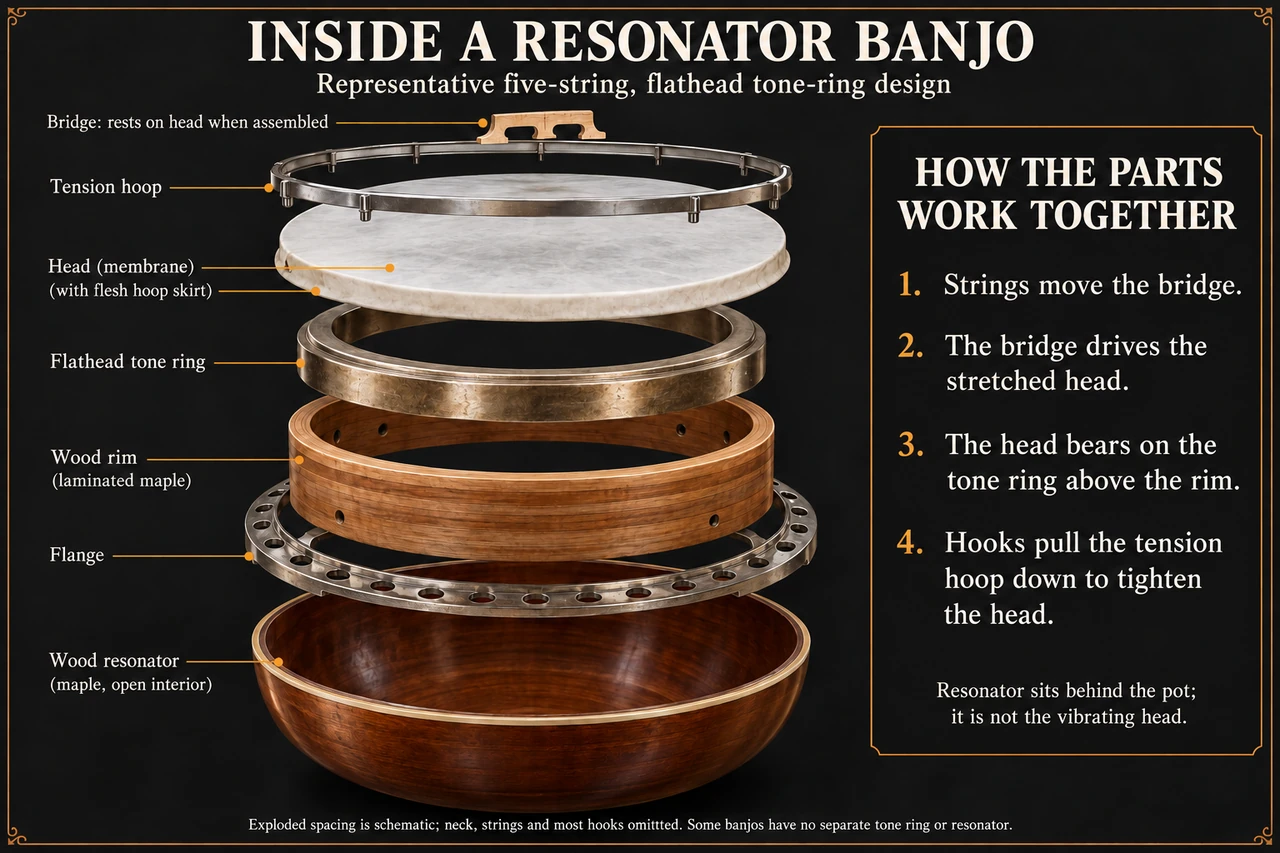
A banjo is built around a small drum called the “pot.” The neck bolts to the side of the pot; the strings cross a floating bridge that sits on the head; the tailpiece anchors the strings at the far edge. There is no soundbox the way a guitar has — the head itself is the speaker.
- Head: a thin membrane (synthetic Mylar or animal skin) tensioned over the rim. The bridge sits on it; vibrations radiate from it.
- Rim (pot): a circular wooden hoop — usually three-ply maple — that the head is stretched over. The rim provides the structural and tonal foundation.
- Tone ring: a metal ring that sits between the rim and the head. Adds mass, projection, and sustain. Bluegrass banjos use heavy bell-bronze tone rings; old-time banjos may have none at all.
- Resonator: a wooden bowl bolted to the back of the rim that reflects sound forward. Removable on many banjos — turns an open-back into a resonator banjo and vice versa.
- Bridge: a small floating maple-and-ebony piece that transfers string vibration to the head. Not glued — held in place by string tension only.
- Tailpiece: a metal anchor at the far edge of the rim where the strings terminate. Adjustable on most modern banjos to set string break angle over the bridge.
- Brackets & hooks: ring of bolts around the rim that pull a metal tension hoop down onto the head, setting head tightness.
- Neck: usually maple or mahogany with a rosewood or ebony fingerboard. Frets are full-height like a guitar — the banjo is a fretted instrument.
- 5th-string peg (5-string only): a tuner mounted on the side of the neck at the 5th fret for the short drone string — the feature that makes a 5-string a 5-string.
- Armrest: a curved metal piece that lets the picking arm clear the sharp tension hoop. Comfort, not tone.
Open-back vs resonator
The biggest decision in banjo gear is whether the back of the pot is open or closed. Each design has a sound and a genre.
| Style | Genre | Tonal character |
|---|---|---|
| Open-back | Old-time, clawhammer, Irish | Lighter, warmer, plunkier — sound radiates in both directions, so the player hears the instrument well but the audience hears less projection. Often no tone ring or a light wooden one. |
| Resonator | Bluegrass | Loud, bright, cutting — the wooden bowl reflects sound forward like a horn. Almost always paired with a heavy bell-bronze tone ring. The Earl Scruggs sound. |
| Long-neck | Folk revival | Three extra frets below the standard nut, designed by Pete Seeger so a 5-string could be tuned down to E without losing tension. Same pot, longer scale. |
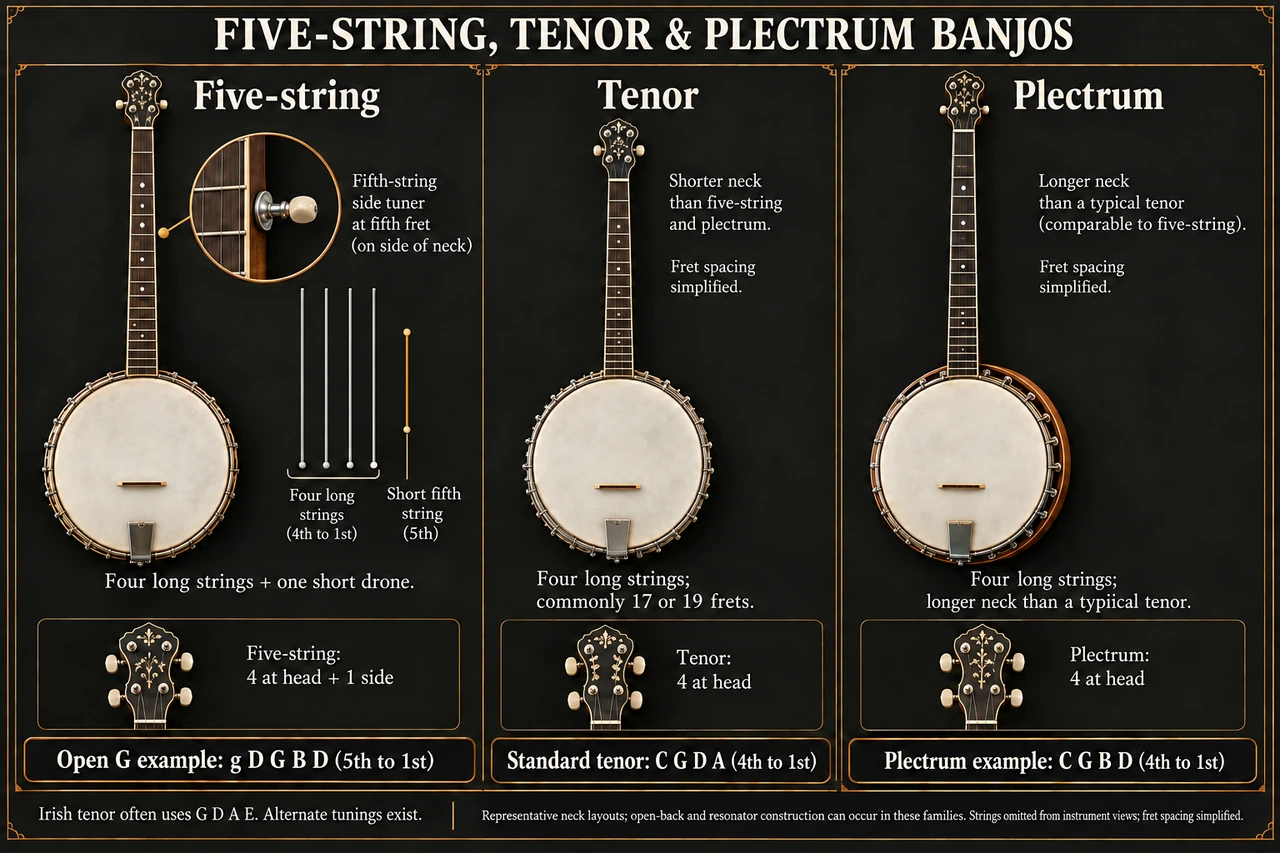
| Tenor / Plectrum | Jazz, Dixieland, Irish | Four-string banjos with no drone string. Tenor has a 17- or 19-fret short scale; plectrum has a longer 22-fret scale. Both built for chordal accompaniment in horn bands. |
| 6-string banjitar | Crossover | A banjo pot fitted with a guitar neck, tuned EADGBE. Plays exactly like a guitar but sounds like a banjo. Popular with guitarists who want banjo timbre without learning a new instrument. |
Tone rings
The tone ring is the metal collar between the rim and the head. Its mass, profile, and material are the single biggest tonal variable a banjo has after the head itself.
- Flathead bell-bronze: the bluegrass standard. A heavy, flat-topped bronze ring, three pounds or more on premium banjos. Loud, bright, percussive — the Mastertone sound.
- Archtop bronze: a raised lip raises the head off the rim only at the outer edge. Sharper attack, thinner mid-range — the older 1920s tenor banjo voice.
- Wood / no tone ring: the clawhammer and old-time choice. Quieter, woodier, more “plunky” — ideal for the down-stroke percussive style and for fingers-only playing.
- Whyte Laydie / Tubaphone: hollow-tube tone rings from early 20th-century Vega banjos. Brighter than wood, sweeter than bell-bronze — popular with classical and minstrel-style players.
- Aluminium / brass alternatives: lighter rings used on student banjos and some vintage models. Less projection than bronze but easier on the back.
Heads
The head is the speaker of the banjo. Material, finish, and tension all change the sound noticeably — more than any other adjustment short of swapping the tone ring.
- Frosted-top Mylar: the modern bluegrass standard (Remo Weather King). Bright, durable, immune to humidity. The white textured top gives a defined, slightly compressed attack.
- Clear Mylar: brighter and snappier than frosted — less internal damping. Some clawhammer players prefer it.
- Coated / fibre-skyn: warmer, more skin-like attack while keeping synthetic stability. A common compromise for old-time players who don’t want to chase humidity.
- Calfskin / goatskin: the original head material. Warm, complex, dynamic — but loosens in damp weather and tightens in dry. Used on minstrel banjos and by tone purists.
- Tension: tighter heads are brighter and louder; looser heads are warmer and plunkier. Bluegrass banjos run high tension (G# or A when tapped at the bridge); old-time players tune lower.
Tunings & variants
“Banjo” means several different instruments. They share a pot but differ in string count, scale length, and tuning — which is why they’re used in completely different musical worlds.
| Variant | Strings (low → high) | What it’s good for |
|---|---|---|
| 5-string (open G) | g D G B D | Bluegrass, old-time, clawhammer. The short 5th string (g) is a high drone that sounds throughout the tune; the rest are tuned to an open G chord. |
| Tenor | C G D A | Jazz, Dixieland, Irish. Tuned in fifths like a viola or mandola — quick chord shapes, easy single-string melody. Irish players often retune to G D A E. |
| Plectrum | C G B D | Tin Pan Alley and trad jazz. Same pitch range as a 5-string with the drone removed; longer scale gives a slightly richer chord tone. |
| Chicago tuning | D G B E | Plectrum or tenor banjo retuned to match the top four strings of a guitar. Lets a guitarist sit in on banjo without learning new chord shapes. |
| Double C (5-string) | g C G C D | An old-time staple. Same pot, retuned to a more melancholic key — many fiddle tunes lay out perfectly under the hand. |
| Sawmill / mountain modal | g D G C D | A modal old-time tuning — neither major nor minor. Heard on Appalachian fiddle tunes like “Shady Grove.” |
Set any of these tunings using the String Warrior tuner — choose your banjo variant from the instrument list. The banjo chord, scale, and progression pages cover each tuning with diagrams matched to the variant you pick.
Bridges
The bridge is the single most under-appreciated part of the banjo. It’s a cheap part with an outsized effect on tone, and a five-minute swap can change the instrument’s voice.
- Standard 5/8” maple-and-ebony: three feet of maple capped with an ebony saddle. The default on almost every banjo. Bright, focused, balanced.
- Heavy / 11/16”+ bridge: taller and denser — rounder bottom end, more sustain, slightly slower attack. Favoured for melodic and bluegrass styles.
- Light bridge: ~1/2” tall — faster, brighter, less low end. Used by old-time and minstrel players.
- Compensated bridge: the saddle is staggered so each string’s speaking length matches its core diameter. Improves intonation up the neck noticeably.
- Placement: the bridge is floating — it’s held in place only by string tension, and you can (and should) check its position whenever you change strings. Aim for the 12th fret to be exactly halfway between the nut and the bridge.
Strings
Banjo strings run lighter than guitar strings — the head and bridge would over-damp anything heavier. Standard 5-string light gauge runs roughly .009–.020w with a .009 or .010 fifth string.
- Nickel-plated steel: the everyday default — bright, balanced, long-lasting. What most players use without thinking about it.
- Stainless steel: brighter and louder than nickel, with longer string life. Some players find them harsh; others love them on bluegrass.
- Phosphor bronze: warmer and woodier — closer to an acoustic guitar tone. Common on old-time setups and some Irish tenor banjos.
- Nylon / nylgut: the original banjo string material, used on minstrel and classic banjos. Soft attack, mellow tone, very different feel under the fingers.
- Loop end vs ball end: most banjos use loop-end strings that hook over the tailpiece pins. A ball-end set will work on tailpieces that accept either, but loop-end is the safer default.
String gauge follows tuning: lighter for 5-string open G, medium for plectrum and Chicago, heavier for tenor in Irish G D A E. Don’t reuse a guitar set — the diameters and the loop ends are wrong.
Picks & technique hardware
How you attack the strings is as much a tonal choice as what bridge you fit. Each style of banjo playing has its own pick or no pick at all.
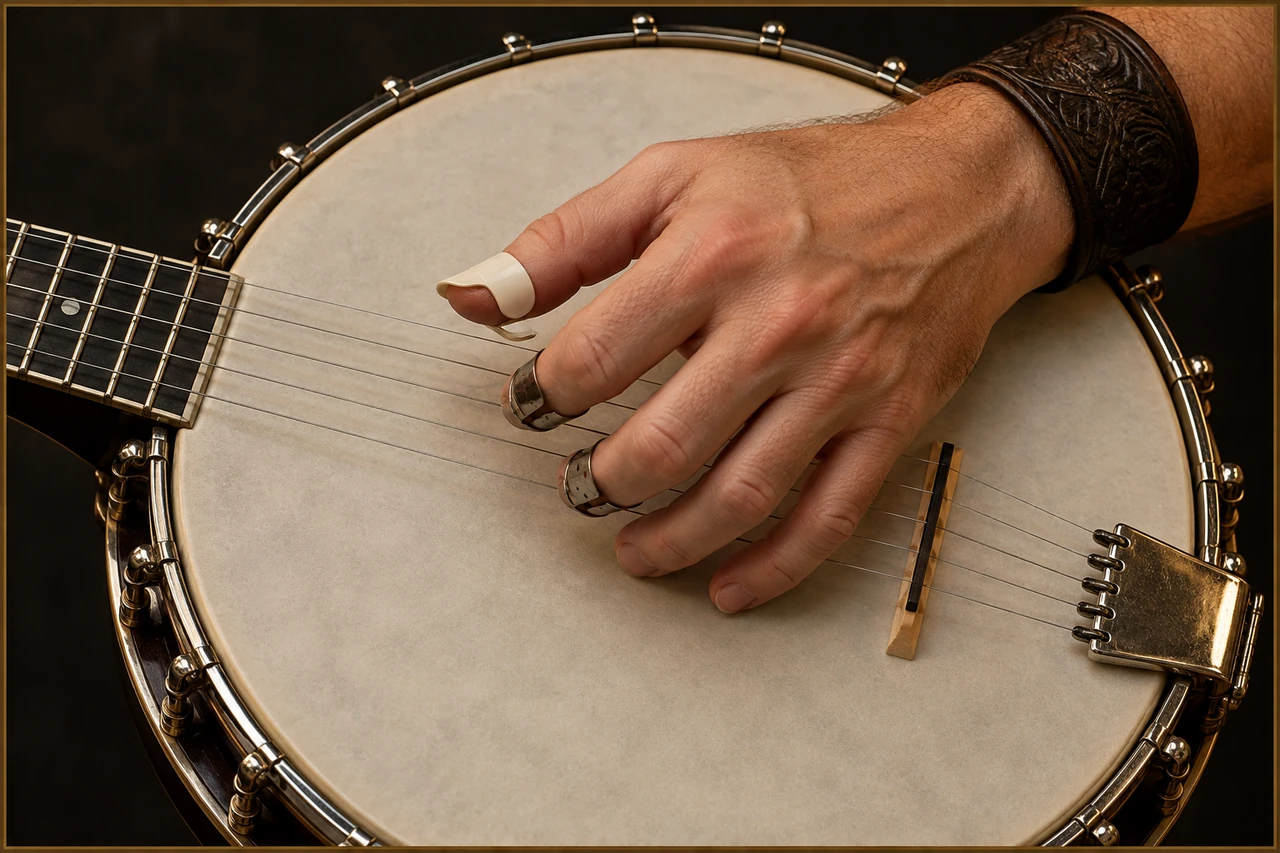
- Fingerpicks (metal) + thumbpick: the bluegrass standard. Two metal fingerpicks (index and middle) plus a plastic thumbpick. Loud, bright, and what Scruggs-style three-finger rolls were designed around.
- Bare fingers (clawhammer): old-time players strike down on the strings with the back of the fingernail and pluck the drone with the thumb. No picks at all — nail length matters.
- Flatpick: a single guitar pick. Standard for tenor and plectrum jazz banjo — fast strums and single-note melodies in horn-band chord-melody style.
- Mute (practice or performance): a clip-on or hooked rubber mute that sits over the bridge. Drops volume by 10–20 dB — useful for apartment practice or for jazz comping at low stage volumes.
- Capo: 5-string banjos use a partial 5-string capo (or a model railroad spike at the 7th, 9th, and 10th frets) to keep the drone string in pitch. A regular guitar capo only works if the 5th string is also retuned.
A short history
The banjo descends from West African gourd lutes brought to the Americas by enslaved Africans. By the early 1800s a fretless gourd-bodied banjo was a common instrument in African-American communities; its first widespread documentation came through 19th-century minstrel shows, which both popularised the instrument and stripped its origins from the public memory.
Late 1800s manufacturers — S.S. Stewart, Vega, Bacon & Day — refined the banjo into a fretted parlour instrument with a wooden rim and metal hardware. By 1910 the four-string tenor banjo had taken over as the chordal engine of early jazz, replacing the guitar in horn bands until amplification made the guitar viable on the bandstand again.
Earl Scruggs reinvented the 5-string in 1945 with three-finger roll patterns and a heavy-bronze flathead Mastertone, and bluegrass banjo as we know it crystallised in the years that followed. The folk revival of the late 1950s and 1960s brought open-back clawhammer playing back to a wider audience, and contemporary players — Béla Fleck, Rhiannon Giddens, Abigail Washburn, Noam Pikelny — continue to expand what the instrument can do.
Related on String Warrior
Once you know the gear, put it to use: